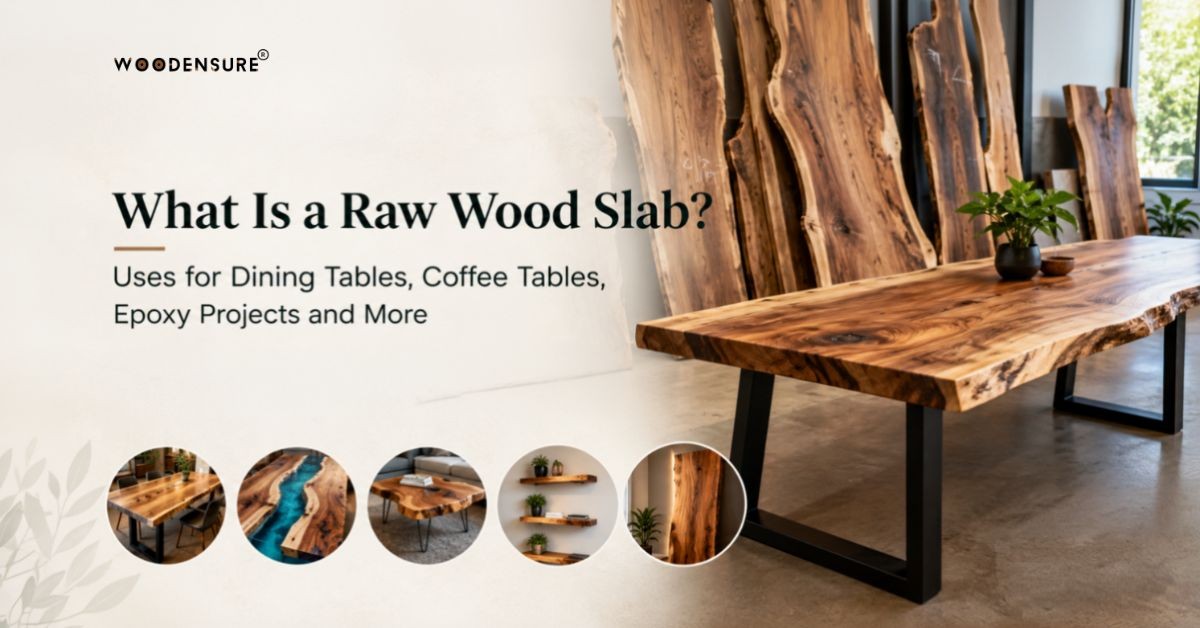
What Is a Raw Wood Slab? Uses for Dining Tables, Coffee Tables, Epoxy Projects and More
A raw wood slab is a thick, solid section of timber cut directly from a log — keeping the natural shape, grain, knots, and live edge of the original tree. Raw slabs are used as tabletops for dining tables, coffee tables, and side tables; as the base material for epoxy resin river projects; and for wall shelving, decorative panels, and DIY woodworking. At Woodensure, raw slabs are available from ₹7,000 to ₹18,000 depending on size and species. Here is everything you need to know before buying one.
Last Updated: 13 October 2026
What Is a Raw Wood Slab?
A raw wood slab is produced by passing a log through a bandsaw or chainsaw mill in a single direction — creating a thick, wide board that retains the full width of the tree at that cross-section. Unlike dimensional lumber, which is milled into uniform beams and boards with all edges cut straight, a slab keeps its natural width variation, organic contours, knots, grain character, and in many cases the curved outer edge of the original tree.
The word "raw" refers to the state of preparation, not the type of wood. A raw slab has not been fully finished for furniture use — it typically still needs assessment for moisture content, flattening to remove saw marks and minor warping, edge preparation, void filling, sanding, and protective finishing before it becomes a functional tabletop or shelf. What it has — and what manufactured furniture boards do not — is an unprocessed relationship with the tree it came from. The grain, the knots, the variation in width, and the character of the edge are all exactly as the tree produced them.
This is precisely why raw wood slabs have become the material of choice for makers, interior designers, and homeowners who want furniture that carries visible authenticity. No two slabs from the same species, or even from the same log, look identical. The dining table made from a particular slab is the only dining table that will ever look exactly like it.
Raw Wood Slab vs Live Edge Slab — What Is the Difference?
These two terms are often used interchangeably but they describe different things.
A raw wood slab describes the state of preparation — it is solid timber that has not been fully finished. A live edge slab describes the edge profile — it is a slab that retains the natural, irregular outer edge of the tree on one or both long sides.
Every live edge slab is a raw slab. But not every raw slab is a live edge piece. Some raw slabs are cut with straight edges on both long sides — useful for tabletops where clean, uniform edges are needed. These are still raw slabs (they need the same preparation work) but they are not live edge.
For dining tables and epoxy river projects, live edge slabs are the most commonly chosen format because the natural edge becomes the central design feature of the finished piece. For desks, countertops, and clean-lined tabletops, straight-cut raw slabs are often more practical.
Types of Raw Wood Slabs
| Type | What it is | Best used for | Edge profile |
|---|---|---|---|
| Live edge slab | Natural outer edge of tree preserved on one or both sides | Dining tables, coffee tables, statement shelves, epoxy river tables | Organic, irregular, curved — unique per piece |
| Straight-cut slab | Both edges cut straight — full slab width, no live edge | Clean-lined tabletops, work surfaces, countertops | Straight, uniform |
| Book-matched slab pair | Two consecutive slabs from the same log, opened like a book — grain mirrors symmetrically across the join | Epoxy river tables, statement dining tables | Mirror-image natural edges facing inward |
| Cross-cut round / cookie | Horizontal cross-section of log — circular, shows full growth rings | Coffee table tops, wall art, decorative surfaces, serving boards | Circular, natural bark perimeter |
| Figured / character slab | Unusual grain patterns — curly, burled, spalted, or deeply wavy | Decorative focal pieces, luxury tabletops, wall panels | Varies — often live edge |
8 Uses for Raw Wood Slabs — From Dining Tables to Epoxy Projects
1. Dining Table Top
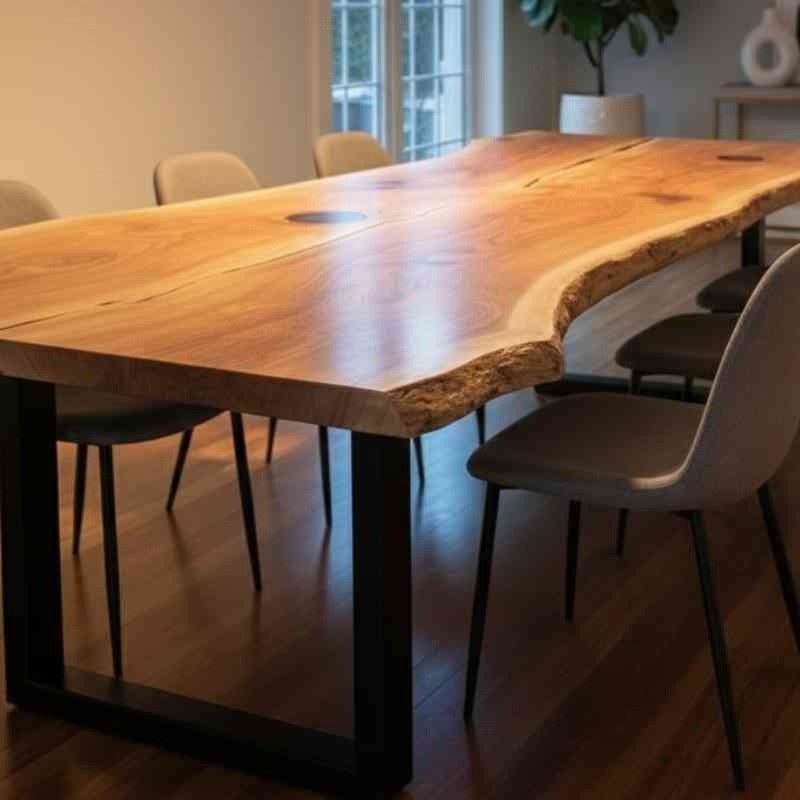
The most popular use for a large live edge slab in Indian homes. A single wide slab — typically 4 to 6 feet long and 2 to 2.5 feet wide — becomes the entire dining table surface, with its natural edge on the long sides creating an organic silhouette that no manufactured tabletop can replicate.
The slab is paired with a base — most commonly black powder-coated metal legs for a modern contrast, or solid wood legs for a more traditional character. The slab's natural width variation means one end of the table may be slightly wider than the other, which is not a defect but a characteristic of the material.
For larger tables seating 6 to 8, a book-matched slab pair with an epoxy river channel between them is the river table format — the two facing live edges create a natural opening that gets filled with coloured resin.
2. Epoxy Resin River Table
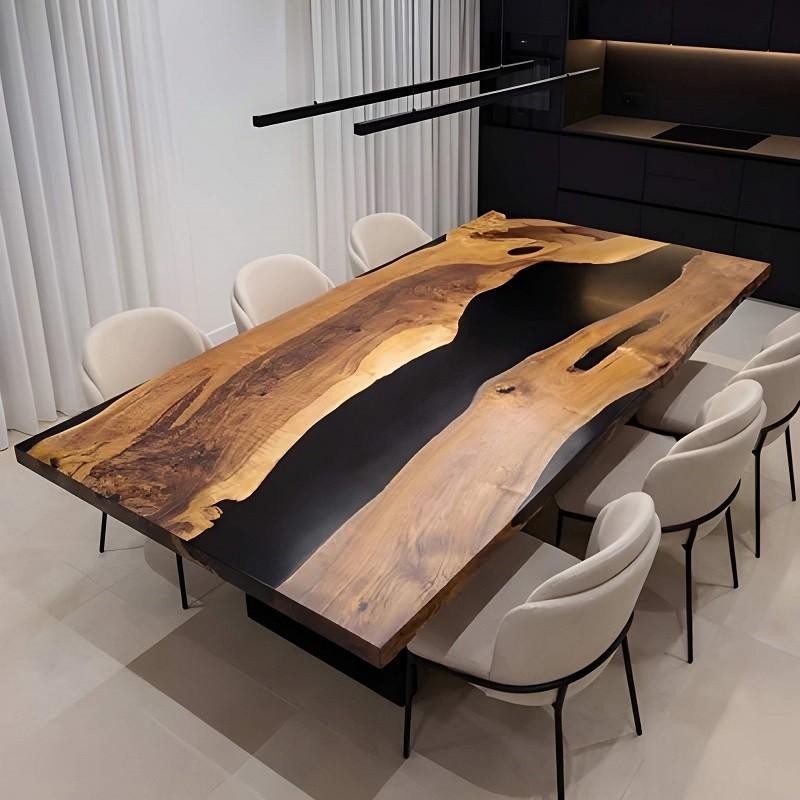
The most visually dramatic use for a book-matched slab pair. Two live edge slabs are positioned with their natural edges facing inward, creating a channel between them. Coloured epoxy resin — blue, teal, coal black, pitch black, snowy white, or ocean blue — is poured into this channel and cured over multiple stages, creating the river effect that gives this furniture its name.
The finished table is a single continuous surface where natural wood and flowing resin coexist. The natural edge profiles of the two slabs determine the exact shape of the river — no two river tables look identical because no two slab pairs produce the same channel shape. This is the fundamental difference between a bespoke epoxy river table and a manufactured piece: the river's form comes from the tree, not from a template.
The slab selection for an epoxy project requires specific attention. Both slabs must have matching or complementary grain, similar thickness across their lengths, compatible natural edge profiles, and appropriate moisture content before the resin work begins.
3. Coffee Table or Center Table Top
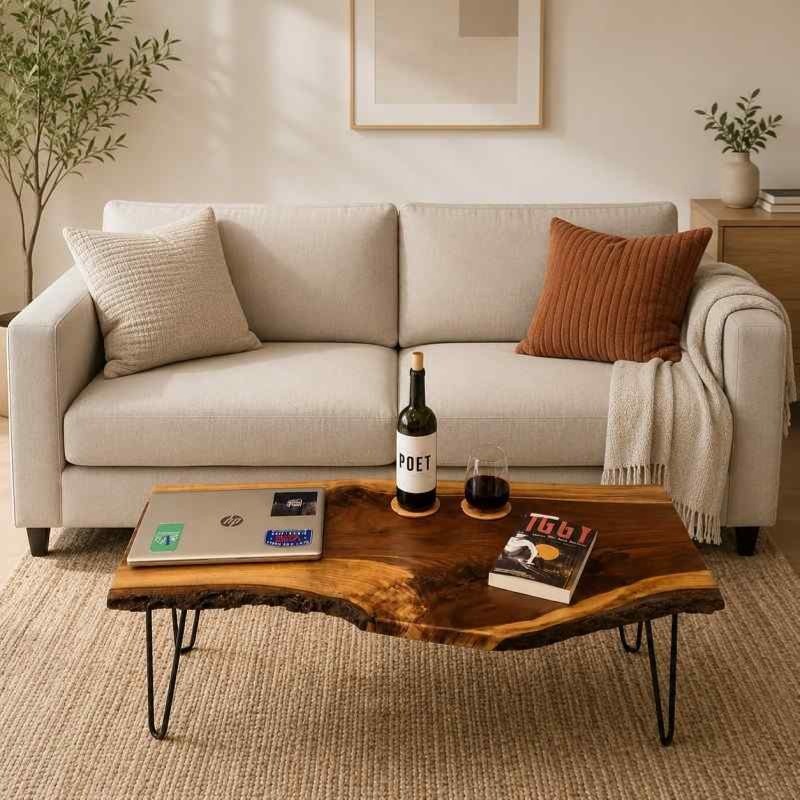
Smaller slabs — typically 2 to 3 feet long and 1.5 to 2 feet wide — make striking coffee table and center table tops when combined with hairpin legs, metal pin legs, or a custom solid wood base. A single slab coffee table with a natural live edge on one or both long sides creates a living room focal point that manufactured center tables cannot match.
The natural edge on a coffee table is particularly effective because the piece is viewed closely and from above — the grain detail, natural contours, and any knots or voids in the wood are clearly visible. A slab with an interesting grain pattern or distinctive edge profile works harder on a coffee table than on a dining table where most of the surface is covered with plates and dishes.
Cross-cut round sections — circular slab discs showing the full growth ring pattern of the tree — also make distinctive coffee tables at any height, typically mounted on a simple metal or wooden base.
4. Floating Wall Shelf
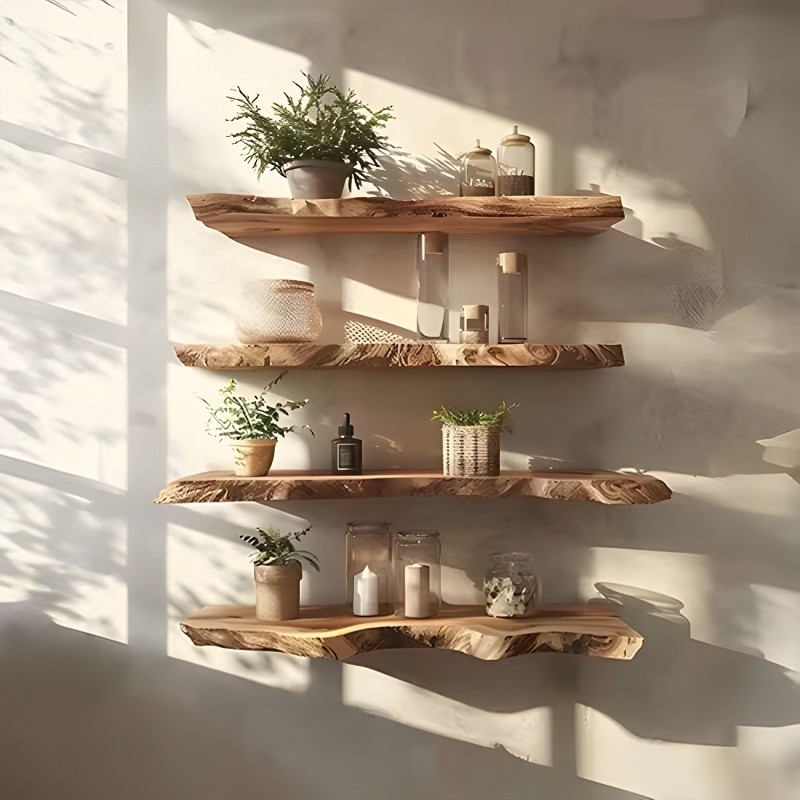
A single live edge slab mounted on concealed wall brackets becomes a floating shelf with far more visual character than any manufactured shelf. The natural edge of the slab faces outward into the room, creating an organic silhouette against the wall — the line between wall and shelf is not straight but follows the original contour of the tree.
Used in living rooms as display shelves for books, plants, and decor, in home offices as a long single work surface, in bedrooms as a headboard-adjacent display shelf, or in kitchens as a spice shelf above the counter. Narrower slabs — 8 to 12 inches wide — are the most practical for wall-mounted applications because they do not project too far from the wall.
The visual effect of a live edge slab shelf is disproportionate to its size — even a small slab shelf at 2 to 3 feet long transforms a blank wall into a designed surface.
5. Office Desk or Work Surface
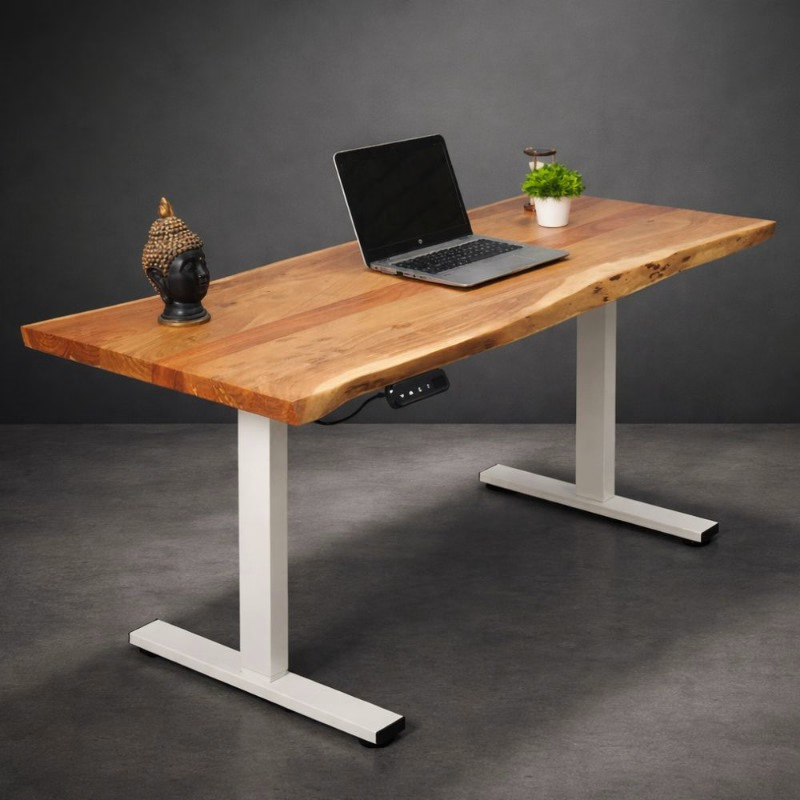
A wide slab — 5 to 6 feet long, 2 to 2.5 feet wide — makes an exceptional home office desk when mounted on adjustable metal legs, fixed metal legs, or a solid wood base. The single-slab desk surface has no seams, joints, or lamination anywhere across its width — it is one continuous piece of natural timber.
This matters practically as well as aesthetically. A seam-free surface is stronger across its width, has no joints that can open with humidity changes, and provides a completely smooth work surface from edge to edge. Live edge slabs used for desks typically have the natural edge on the front long side — the edge facing the user — creating a desk where you work against an organic wood contour rather than a manufactured straight line.
6. Kitchen Countertop or Bar Top

A thick slab — 40mm or above — used as a kitchen island top or bar countertop brings natural warmth to surfaces that are typically stone, laminate, or stainless steel. In Indian kitchens, this application is most practical for bar tops, kitchen island surfaces, or butler's counters rather than primary cooking surfaces adjacent to the hob and sink — areas with sustained water and heat exposure require a finish that solid wood cannot hold as long as stone.
For bar tops and island surfaces, a properly sealed hardwood slab is durable, visually striking, and develops a patina with use that adds character over time. The slab must be sealed with a food-safe, heat-resistant finish. All voids and checks must be filled before finishing to prevent moisture ingress.
7. Wall Panel or Decorative Feature
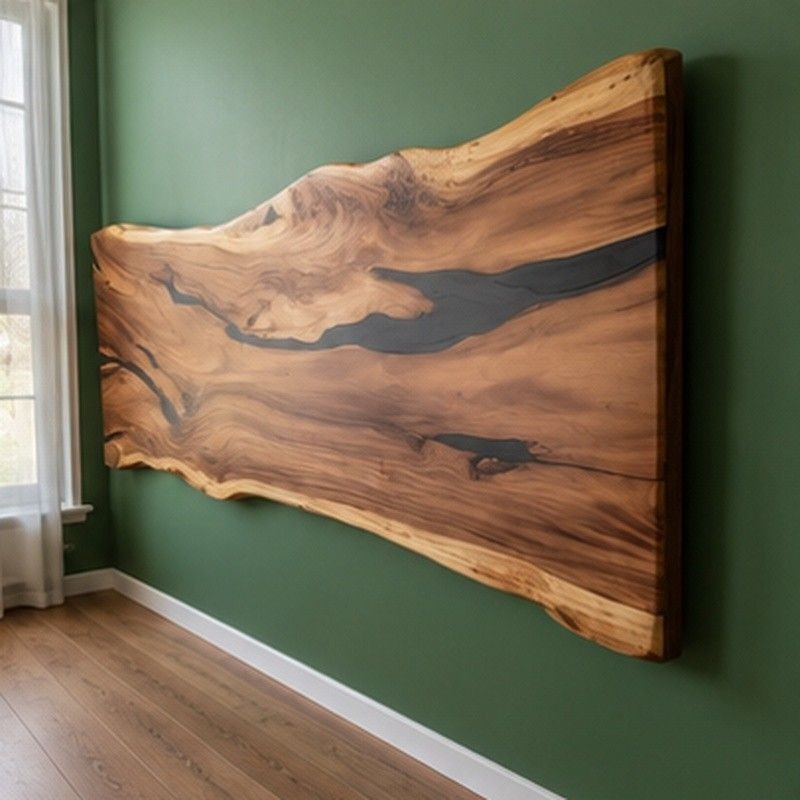
Thinner slabs — 20 to 25mm — mounted horizontally or vertically on a wall create a natural wood feature panel with grain depth and texture that no wallpaper, paint, or manufactured wood panel can replicate. In Indian homes, a wood feature wall in the living room or master bedroom — particularly behind a sofa or above a bed — has become one of the most sought-after interior design elements.
A single large slab mounted vertically above a bed headboard creates a natural wood headboard effect that extends to the ceiling, making the bedroom feel significantly taller and more designed without any structural change. In restaurants and hotels, live edge wood wall panels are increasingly used as signature design elements at entry points and behind reception desks.
8. DIY Woodworking and Custom Projects

Raw slabs are the primary starting material for DIY furniture makers, resin artists, interior designers sourcing natural material for bespoke projects, woodworking students, and craft professionals building custom commercial furniture for cafes, restaurants, and boutique spaces.
Buying a raw slab gives the maker complete control over every downstream decision — final dimensions, edge treatment, whether to add resin, finish type, leg style, and overall form. Common DIY slab projects include: epoxy resin art panels, natural edge serving boards, decorative wooden trays, side table tops, headboards, and signature commercial pieces for food and beverage businesses.
How to Choose the Right Raw Wood Slab for Your Project
| Decision | What to consider | Practical guide |
|---|---|---|
| Size | Length, width (average — live edge width varies), thickness | Dining table: minimum 40mm thick. Coffee table: 25–35mm adequate. Width on live edge slabs varies along the length — confirm minimum usable width, not maximum |
| Wood species | Hardness, grain character, colour, Indian climate performance | Acacia: hardest (Janka 1,700 lbf), honey-golden, best for Indian humidity. Sheesham: rich dark grain, traditional look. Mango: lighter, more affordable, good for smaller pieces |
| Moisture content | Kiln-dried vs green (undried) | For furniture use, moisture content should be 8–12%. Green timber warps and checks as it dries. Always confirm moisture content before ordering for a furniture project |
| Edge profile | Live edge vs straight-cut vs book-matched | Epoxy river table: book-matched pair with facing live edges. Single slab dining table: one or both live edges. Clean-lined desk: straight-cut both sides |
| Natural characteristics | Knots, checks, sapwood, cracks, bark | Small knots and grain variation are character features, not defects. Large through-cracks need epoxy filling. Loose bark should be removed before use |
| Application | Indoor vs outdoor, load-bearing vs decorative | All wood slab furniture is indoor use only without specific outdoor treatment. Load-bearing pieces (dining tables, desks) need 40mm+ thickness |
Raw Wood Slabs and the Indian Climate — What to Know Before You Buy
India's monsoon season brings 70 to 90 per cent relative humidity in coastal cities and 60 to 80 per cent in inland cities for three to four months each year. Wood slabs that have not been properly kiln-dried will absorb this seasonal moisture, expand across the grain, and develop checks — small splits along the grain direction — or warp across their width. Neither outcome is a failure of the wood; it is wood behaving exactly as wood does when its moisture content changes significantly.
Kiln-dried slabs, dried to a moisture content of 8 to 12 per cent before they leave the workshop, are significantly more stable. They still respond to seasonal changes — all wood does — but within tolerance that does not damage the finished piece. All Woodensure raw slabs are kiln-dried before listing.
Before using a slab for a furniture project, acclimatise it in the room where it will live for 7 to 14 days. This allows the wood to reach equilibrium with that room's specific humidity level. Flattening and finishing a slab before this acclimatisation period can result in movement in the finished piece as the wood adjusts after completion.
Storage before use: keep the slab horizontal, supported at multiple points along its length, in a dry indoor space away from direct sunlight and damp floors. Do not store vertically — a slab leaning against a wall will sag at its unsupported middle over time. Wrap in breathable cloth rather than plastic sheeting to allow air circulation while protecting from dust.
Raw Wood Slab Prices in India — What to Expect
| Slab type | Nominal size range | Best use |
|---|---|---|
| Natural edge slab (smaller) | 2×1.75 ft to 3×1.6 ft | Coffee table tops, smaller DIY projects, wall art panels |
| Live edge slab (medium) | 3×2 ft to 3×3 ft | Coffee tables, side tables, medium DIY projects |
| Live edge slab (large) | 4×1.6 ft and above | Dining tables, desks, epoxy river projects |
Slab prices vary with wood species, thickness, grain figure, edge profile, and availability. Because natural slabs are not manufactured to uniform specifications, the price reflects the individual slab's character and usable dimensions. Book-matched slab pairs for epoxy river projects are available on enquiry — contact via WhatsApp with your project dimensions, intended use, and whether you need matching grain or are open to complementary profiles.
Find the Right Slab for Your Project
Every raw wood slab at Woodensure is photographed individually — what you see is the actual piece available, with its specific grain pattern, edge profile, and natural character. No two slabs are alike.
WhatsApp: +91 93586 76060 — share your project dimensions, intended use, and whether you need a specific size or are open to what is available. The team will confirm stock and provide a quote within one working day.
Browse Raw Wood Slabs: woodensure.com/home-decor/raw-wood-slabs
Custom Furniture from a Slab: woodensure.com/customization
Related reading:
- Epoxy Resin Dining Table Buying Guide — Types, Sizes, Colours and Care
- Live Edge Dining Table Buying Guide — Wood, Finish and How to Choose
- How to Order Custom-Made Furniture in India — Size, Wood, Price and What to Tell the Manufacturer
- Solid Wood Furniture Buying Guide for Indian Homes 2026
Author Bio:
Written by the Woodensure craftsmanship team — solid wood and epoxy resin furniture manufacturers in Udaipur, Rajasthan, working with raw wood slabs daily in our in-house workshop.