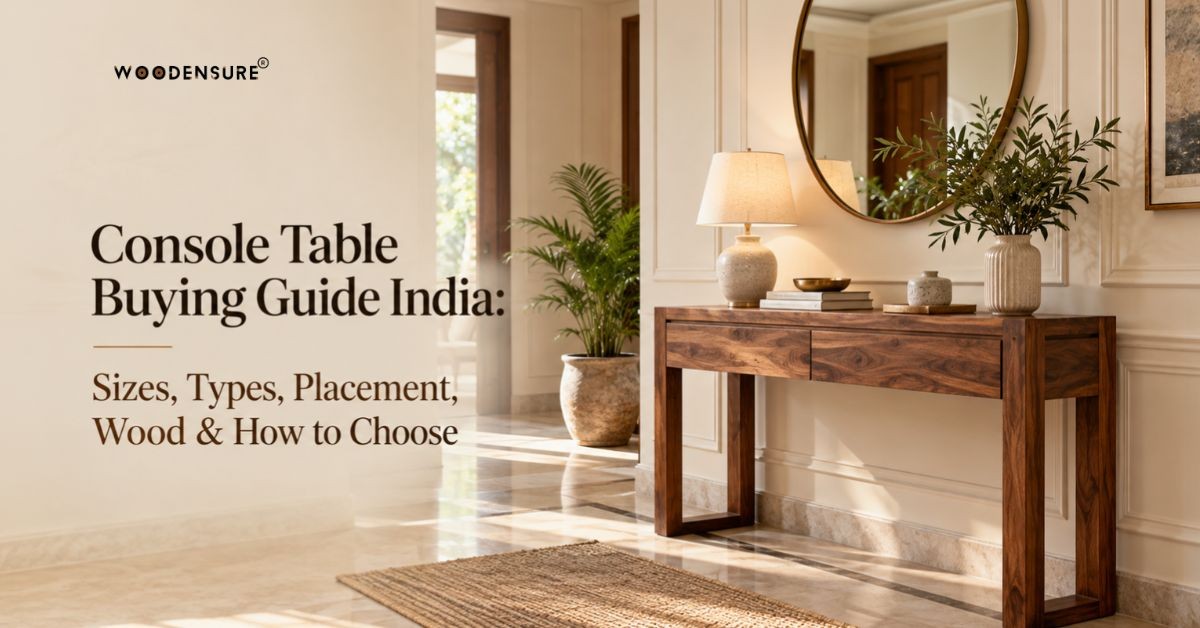
Console Table Buying Guide India: Sizes, Types, Placement, Wood & How to Choose
A console table is a slim, wall-placed table used for entryways, hallways, behind sofas, or against living room walls. Standard size in India: 36–48 inches wide, 12–16 inches deep, 30–36 inches tall. Prices range from ₹8,500 for a compact solid wood model to ₹26,000 for a premium live edge console. Key buying decisions: room placement, storage requirement (with or without drawers), wood type, and style. Here is the complete console table buying guide for Indian homes.
Last Updated: 30 September 2026 | Written by the Woodensure craftsmanship team — solid wood and epoxy resin furniture manufacturers in Udaipur, Rajasthan. Every console table in this guide is made in our in-house workshop and shipped pan-India.
What Is a Console Table and Why Does It Work So Well in Indian Homes
A console table is a narrow, wall-placed table — typically 12–16 inches deep — that takes up minimal floor space while adding a usable surface and a visual anchor to any room. Its slim profile is the defining characteristic that separates it from a dining table, a sideboard, or a cabinet. It sits against the wall, holds things on its surface, and asks almost nothing of the floor plan in return.
This is precisely why it works so well in Indian homes. The average Indian 2BHK or 3BHK has three spaces that standard furniture cannot fill: the entry passage near the main door, the wall behind the sofa in the living room, and the hallway connecting the rooms. A large dining table is too deep. A wardrobe is too tall and enclosed. A console table fits all three positions with its slim footprint and open design.
It solves three specific problems Indian homeowners face consistently. First, an empty wall that looks unfinished — a console table with a mirror or floating shelf above it creates a complete vignette from floor to ceiling. Second, a hallway or entry with no designated storage or display space — a console with a drawer keeps keys, remotes, and daily items organised without a dedicated storage unit. Third, an open-plan flat where the living area bleeds into the kitchen or dining area — a console behind the sofa creates a visual boundary without any construction.
At Woodensure, every console table is made from solid Acacia or Sheesham hardwood in the Udaipur workshop — not assembled from imported flat-pack components or engineered wood panels.
Console Table Size Guide for Indian Homes
Sizing is the single decision that most buyers get wrong — not because they choose the wrong style, but because they measure the wall rather than the floor space in front of it. A console table must leave adequate walking clearance on all sides. In Indian homes, where passages and hallways are often narrower than in Western homes, the depth dimension matters more than the width.
| Placement | Recommended width | Max depth | Standard height | Indian flat context |
|---|---|---|---|---|
| Narrow hallway | 30–36 inches (76–91 cm) | 10–12 inches (25–30 cm) | 30–34 inches | Mumbai/Delhi corridor: typically 3.5–4 ft wide — max 10 inch depth leaves comfortable walking space |
| Entryway / foyer | 36–48 inches (91–122 cm) | 12–16 inches (30–40 cm) | 30–36 inches | Standard 2BHK entry: 5–7 ft wide — a 48 inch console leaves room for door swing and foot traffic |
| Behind sofa | Two-thirds of sofa length | 12–14 inches (30–35 cm) | At sofa back height or slightly lower | Standard Indian 3-seater sofa = 84 inches; ideal console width = 54–60 inches |
| Living room feature wall | 48–60 inches (122–152 cm) | 14–16 inches (35–40 cm) | 30–36 inches | Statement piece — live edge or sculptural leg design earns its visual weight on a large wall |
| Bedroom / vanity corner | 30–42 inches (76–107 cm) | 12–16 inches | 30–34 inches | Pair with a stool for a compact dressing setup without a dedicated vanity unit |
One India-specific sizing note: Indian electrical switch panels are mounted at 44–48 inches from the floor as per IS 732 standards. If you are placing a console table below a switch panel, make sure the table height plus any decor items on it clears the switch by at least 4 inches. A 34-inch console with a 10-inch lamp (44 inches total) sits exactly at switch panel height — plan for this before ordering.
The depth rule for Indian hallways: Leave a minimum of 36 inches of walking clearance between the console table and the opposite wall. In a 4-foot-wide hallway (48 inches), a 12-inch-deep console leaves exactly 36 inches — the minimum. Go to 10 inches depth for comfort. In any hallway under 3.5 feet wide, skip the console table and use a floating wall shelf instead.
Types of Console Tables — Which Style Is Right for Your Home

Six distinct types of console tables are available, each suited to a different combination of room, interior style, and use case. Understanding the differences before buying prevents the most common mistake in this category — choosing on aesthetics alone without considering function and fit.
| Type | Best for | Key feature |
|---|---|---|
| Solid wood, straight edge | Entryways, hallways, traditional and modern interiors | Clean lines, versatile with any decor, easiest to maintain and touch up |
| Live edge | Living rooms, statement walls, luxury interiors | Natural slab edge preserved — every piece unique, no two identical |
| Rustic / boho | Farmhouse, earthy, eclectic homes, cafes, homestays | Visible grain, knots, raw character, warm earthy finish |
| With drawers / storage | Entryways with heavy daily use (keys, remotes, mail) | Hidden storage keeps surface clutter-free at the busiest point in the home |
| Sculptural / artistic legs | Living rooms, luxury interiors, design-forward homes | The leg design itself is the visual statement |
| Metal base frame | Industrial, modern, contemporary flats | Wood top with metal frame — warmth plus structural contemporary look |
The storage question. The single most practical decision before buying: do you need drawers or not? For an entryway that handles keys, remotes, charging cables, small accessories, and daily mail — yes, drawers are worth the additional cost. They contain the inevitable daily-use clutter that would otherwise accumulate on the open surface and defeat the purpose of having a styled console at all. For a behind-sofa console or a decorative living room piece, open design without drawers is cleaner and more visually open.
Console Table Placement Guide — Room by Room for Indian Homes
Where you place the console table matters more than which one you buy. A beautiful live edge piece in the wrong position — too deep for the hallway, too wide for the entry, too tall behind the sofa — looks wrong regardless of its quality. Here is the room-by-room guide for Indian home placements.
Entryway and Main Door Area

The entryway is the highest-impact placement for a console table — it is the first piece guests see and the last piece you interact with before leaving the house. It should be welcoming, functional (a tray for keys, space for items you grab on the way out), and sized to leave full door swing clearance plus comfortable foot traffic space.
Always leave a minimum of 36 inches of walking space between the console and the opposite wall or door. A mirror above the console — width should be 60–80% of the console's width — makes a narrow entry feel significantly wider and adds practical functionality at the entrance.
Vastu tip: placing a console table in the North or North-East of the entryway, with a small Ganesha idol, a lit diya, and a Tulsi plant or fresh flowers on top, is considered highly auspicious for welcoming positive energy into the home. Avoid placing it directly blocking the door's swing path, and keep the surface clean and uncluttered — a cluttered threshold creates stagnant energy in Vastu.
Recommended type: Solid wood with drawers for heavy daily use. Live edge for a purely decorative entryway where keys and items are stored elsewhere.
Living Room — Behind the Sofa

Most effective in open-plan flats or living rooms where the sofa floats away from the wall rather than being pushed against it. A console table placed directly behind the sofa creates a visual "back" to the seating zone, defines the living area from the dining or kitchen space without any partition wall, and adds a surface for a lamp, a plant, and decor.
The size rule: the console should be approximately two-thirds the length of the sofa, and its height should be at or slightly below the sofa back — a console taller than the sofa back looks disproportionate and blocks sightlines. A standard Indian 3-seater sofa is 84 inches long; the ideal behind-sofa console is 54–60 inches wide.
Recommended type: Rustic woodland or live edge — the natural character of the wood works with both the sofa's upholstery and the living room decor. Clean-line solid wood for modern interiors.
Hallway

A console table in a hallway transforms a blank passage into a designed, purposeful space. The hallway is one of the most neglected spaces in Indian homes — and one of the easiest to upgrade without renovation. Keep depth minimal: 10–12 inches in a narrow hallway. Use the wall above for a mirror or a set of floating shelves.
Keep the styling minimal. In a hallway, a cluttered console makes the passage feel more cramped than an empty one. One plant, one lamp, one tray — three items maximum, all at different heights. The table itself carries the design weight; the decor is the supporting cast.
Recommended type: Slim solid wood or a compact live edge piece. Avoid bulky designs or pieces with large bottom shelves that reduce the visual airiness of the passage.
Living Room — Feature Wall

A wider console (48–60 inches) on an empty living room wall anchors the room the way a painting or a TV unit does — except it also provides a functional surface. This placement works especially well in living rooms where the TV is mounted on a different wall and the remaining walls are underused.
A live edge or sculptural leg console at this scale does the visual work entirely on its own — no wall art needed above it, and no additional decor is required on the surface. The piece is the statement.
Recommended type: Live edge with sculptural wooden legs for maximum visual impact. Wide live edge with metal base for a modern luxury look.
Bedroom

In the bedroom, a console table works as a compact vanity (add a stool at 18–20 inches height and a mirror above), a bedside display surface for books and plants, or a dedicated decor surface for collections and personal items. A width of 30–42 inches suits most Indian bedroom layouts without dominating the room.
Recommended type: Artisan mirror live edge or compact solid wood. Avoid very rustic or heavily textured pieces in the bedroom — the bedroom benefits from calmer surfaces.
Wood and Material Guide — What Lasts in the Indian Climate
The material decision is where most buyers make the costliest long-term mistake — choosing engineered wood or MDF for a lower upfront price, then replacing the piece within 3–5 years when it swells, delaminates, or peels in India's humid climate. Here is the honest comparison.
| Material | Character | Hardness / durability | Best for | Indian climate performance |
|---|---|---|---|---|
| Acacia | Honey-golden, tight grain, warm | Janka 1,700 lbf — harder than Oak | Live edge, statement pieces, modern and traditional | Excellent — dense grain resists monsoon humidity, kiln-dried for stability |
| Sheesham (Indian Rosewood) | Rich brown-gold, interlocked grain | High — traditional Indian hardwood | Rustic, traditional, transitional interiors | Very good — used in Indian homes for generations without warping |
| Mango wood | Light golden-brown, visible grain | Medium — softer than Acacia | Casual, boho, rustic interiors | Good for indoor use, avoid in high-humidity rooms like kitchens |
| MDF / engineered wood | Uniform, no grain, smooth surface | Low — swells and peels in humidity | Budget short-term furniture | Poor — warps and delaminates in Indian monsoon; not recommended for lasting use |
| Metal base (with wood top) | Structural, contemporary | Very high for base | Industrial and modern interiors | Excellent for the base — pair with solid wood top for full durability |
Why solid wood outperforms engineered alternatives in India. India's monsoon season brings sustained high humidity — 70–90% relative humidity in coastal cities like Mumbai and Chennai, 60–80% in inland cities. At these levels, MDF absorbs moisture, swells at joints and edges, and begins to delaminate within a few seasons. Solid wood, particularly kiln-dried Acacia and Sheesham, expands and contracts within tolerance at Indian humidity levels without structural damage.
At Woodensure, all console tables use kiln-dried solid wood — moisture-tested before manufacturing to ensure dimensional stability through Indian monsoon seasons. MDF and engineered wood are not used in any Woodensure product at any price point.
How to Choose the Right Console Table — Decision Guide
| Your situation | What to choose | Why | Woodensure pick |
|---|---|---|---|
| Narrow hallway, less than 4 ft wide | Slim solid wood, max 10 inch depth, 30–36 inches wide | Leaves walking space, does not block movement or feel imposing | Wilderness ₹8,500 |
| Main entryway with heavy daily use | Console with drawers or storage shelf | Keeps keys, remotes, mail out of sight — surface stays clean | Rustic Boho with Rattan Drawers ₹16,500 |
| Living room statement feature wall | Live edge or sculptural leg design, 48–60 inches wide | One strong piece anchors the entire wall without needing wall art | Sculptural Live Edge Console ₹26,000 |
| Behind a floating sofa | Clean-line console at sofa back height, two-thirds sofa length | Creates visual zone without blocking sightlines into the room | Rustic Woodland ₹13,200 |
| Bedroom vanity corner | 30–42 inches wide, 30–34 inches tall, with or without drawer | Compact footprint — paired with a stool creates a full dressing area | Artisan Mirror Live Edge ₹14,520 |
| Modern or industrial flat | Wood top with metal base frame | Metal base reads contemporary; wood top adds warmth and prevents the look feeling cold | Live Edge with Metal Base ₹17,050 |
Console Table Price in India — What to Expect at Each Budget
| Budget | What you get |
|---|---|
| Under ₹10,000 | Compact solid wood, straight edge, clean-line design — ideal for hallways and small entryways |
| ₹10,000–₹16,000 | Live edge slab, more design character, larger surface, rustic or mid-century finish |
| ₹16,000–₹20,000 | Live edge with metal base, rattan drawer storage, larger widths, nature-inspired designs |
| ₹20,000+ | Premium statement pieces — sculptural legs, handmade live edge slab, luxury entryway or living room focal point |
How to Style a Console Table — The Three-Item Rule
A console table looks its best when it is not overcrowded. The most effective approach uses exactly three items at different heights: one tall item, one medium item, and one small item. This creates visual depth without clutter.
For Indian homes specifically: a brass or copper diya as the small item adds warmth and cultural authenticity that generic imported decor does not match. A Tulsi plant, a small indoor fern, or a money plant as the medium item works across both modern and traditional palettes — and in Vastu, a living plant at the entrance brings fresh energy into the home. A tall brass or wooden lamp on one end (never centered) creates depth and shadow that makes the whole setup look intentional.
What to avoid. More than five items on the surface makes any console look like a shelf that was never edited. Items all at the same height read flat and unplanned. Matching decor sets purchased together look assembled rather than curated — a mix of textures (wood, ceramic, metal, plant) reads far more naturally.
Mirror sizing. For a mirror above the console: aim for 60–80% of the console table's width. A 48-inch console looks best with a 28–38 inch wide mirror. A mirror wider than the console looks top-heavy; narrower than 60% looks like an afterthought.
Find the Right Console Table for Your Home
Every Indian home has a different entryway width, sofa length, and wall space. If you are not certain which size, style, or wood is right for your specific situation, the Woodensure team can help — share your room dimensions and a photo on WhatsApp and get a personalised recommendation from the people who make the pieces.
WhatsApp: +91 93586 76060 — share your room dimensions, placement area, and interior style. Response within one working day.
Browse all console tables: woodensure.com/console-table
Related reading:
- Side Table vs Center Table vs Console Table — Which One Do You Actually Need?
- Main Door Vastu Tips — Direction, Colour and Wood Material for Indian Homes
- 10+ Living Room Furniture Ideas for Small Indian Homes 2026
- How to Order Custom-Made Furniture in India — Size, Wood, Price and What to Tell the Manufacturer