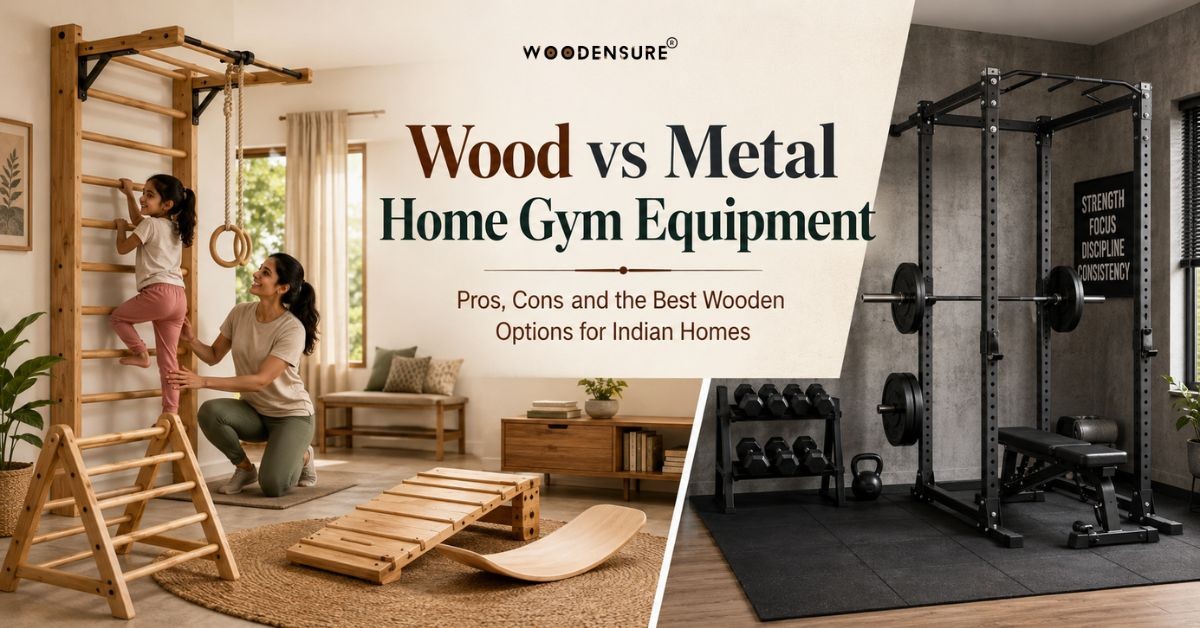

Wood vs Metal Home Gym Equipment: Pros, Cons and Best Wooden Options for Indian Homes
Wood home gym equipment is better than metal for home use in most cases. Wood wins on grip, safety, noise, rust resistance, aesthetics, and space — seven of the eight factors that matter most for a home gym. Metal wins only on load capacity (for heavy barbell training) and is better suited to garage or commercial gyms. For Indian apartments and family homes, wood is the practical, safer, and more durable long-term choice.
This guide walks through all eight factors in detail, explains where each material genuinely wins and why, covers what makes wooden equipment specifically better suited to Indian apartment living, and ends with the five best wooden fitness and play products from Woodensure for families setting up a home gym or kids' activity space.
Last Updated: 29 June 2026
What Counts as Wooden vs. Metal Home Gym Equipment?
Wooden home gym equipment includes Swedish wall bars, gymnastic rings, pull-up bars, balance boards, Montessori climbing arches, Pikler triangles, convertible climbing frames, rope ladders, and disc swings. Metal home gym equipment in the same category includes steel pull-up rigs, powder-coated squat racks, cable machines, steel multi-station units, and metal climbing frames.
This is an important distinction because most comparisons online focus on dumbbells and weight plates — where the rubber vs steel debate is entirely different. This guide covers structural and functional gym equipment: the frames, bars, boards, and climbing structures used for bodyweight training, mobility, stretching, and children's active play.
Wood vs Metal Home Gym Equipment: Quick Comparison At a Glance
| Factor | Wood | Metal | Best Choice |
|---|---|---|---|
| Grip and Hand Feel | Natural friction, warm | Requires knurling or tape | Wood |
| Aesthetics | Furniture-quality | Industrial | Wood |
| Apartment Noise | Silent in use | Clangs, creaks, vibrates | Wood |
| Rust Resistance | Does not rust | Corrodes in humidity | Wood |
| Child Safety | Smooth, no sharp edges | Risk of edges and rust | Wood |
| Load Capacity | Bodyweight training | Heavy barbell loads | Metal (if powerlifting) |
| Space Efficiency | Wall-mounted, compact | Large floor footprint | Wood |
| Eco-friendliness | Renewable, low transport | Energy-intensive, imported | Wood |
For families in Indian apartments prioritising safety, noise, aesthetics, and space, wood wins 7 out of 8 factors. Metal wins only if extreme load capacity for heavy barbell training is the primary requirement.
Wood Vs Metal Home Gym Equipment: Comparing 8 Factors That Matter Most
1. Grip and hand feel

Wood wins.
Natural wood gives your hands something to hold that metal simply cannot replicate. The grain, texture, and slight warmth of solid wood provide passive friction — your hands engage the surface without any assistance. This is not a minor comfort detail. It is the reason gymnasts worldwide have used birch and beech wood rings for over a century, and continue to do so today. Wooden gymnastic rings provide superior grip over metal or plastic rings and work effectively with or without chalk.
Metal pull-up bars and rigs require knurling — the aggressive cross-hatching machined into the steel surface — to prevent slipping. Without it, metal is dangerously smooth. With it, it can be abrasive on skin during long sessions. In cold months, metal bars drop to whatever temperature the room is, which makes early-morning training unpleasant in a way that wood never does. For children climbing a frame or balancing on a board, smooth sanded wood is gentler on small palms and developing grip than cold metal rails.
2. Aesthetics and home integration

Wood wins for living rooms, playrooms, and balconies.
Industrial steel gym equipment belongs in a garage or a dedicated gym room with rubber flooring and concrete walls. Most Indian families do not have either. A powder-coated metal multi-station standing in a living room or a corner of the bedroom looks exactly like what it is: gym equipment that ended up somewhere it does not belong.
Solid natural wood equipment looks like furniture. A wooden Swedish wall bar on a living room wall reads as a design element — warm, natural, considered. A wooden Montessori climbing arch in a playroom blends with the space rather than dominating it. This matters more than most buyers expect, because equipment that fits the room gets used. Equipment that makes a space feel like a temporary gym gets tolerated and eventually removed.
The Montessori educational philosophy, which informs the design of climbing arches, Pikler triangles, and wooden balance boards, makes this explicit: the environment a child plays in should be beautiful, warm, and inviting. Natural wood is the standard material in Montessori-inspired spaces globally because it meets that brief in a way no metal frame does.
3. Noise in apartments

Wood wins decisively.
Metal gym equipment makes noise. Pull-up bars clang on their brackets. Steel frames creak under load. Weights and bars produce vibration that travels through walls and floors. In a multi-storey apartment building — the standard living situation in Indian cities — every sound your equipment makes is heard by at least two neighbouring households.
Wooden climbing frames, balance boards, Swedish ladders, and Montessori arches produce virtually no noise in use. A child rocking on a wooden balance board, climbing a wooden arch, or swinging on a rope hanging from a wooden pull-up bar makes no more noise than someone walking across the room. A parent doing dead hangs or stretches on a wooden wall bar is completely silent.
This is one of the strongest practical reasons Indian apartment families consistently choose wooden play and fitness equipment. It is not about aesthetics — it is about being able to use your equipment at 6 a.m. or 9 p.m. without a conversation with your downstairs neighbour.
4. Durability and rust resistance

Wood wins in humid Indian climates.
Steel and metal do not rust by accident — they rust because they are metal, and metal oxidises when exposed to air and moisture. In India's monsoon season, coastal cities, and humid interiors, untreated or inadequately coated metal gym equipment corrodes faster than manufacturers' specifications assume. The rust typically starts at joints, brackets, screws, and bolts — exactly the structural points where you most need the material to be sound. A frame that looks intact can have compromised fasteners hidden behind a thin surface layer of paint or powder coat.
Solid wood does not rust. Ever. It can absorb moisture if left repeatedly wet, and should be kept dry and wiped down after use. A natural polished wood finish provides adequate everyday protection for indoor and covered outdoor use. The basic care routine — wipe with a soft dry cloth, keep away from direct water, apply a natural wood oil once or twice a year — takes under five minutes and maintains a wooden frame in excellent condition for decades.
The honest counterpoint is that wood can warp or crack if the environment is extremely damp and ventilation is poor. This is rarely a practical issue for indoor home gym equipment in normal living conditions, but it is worth knowing: do not store wooden gym equipment in a waterlogged basement or leave it drenched repeatedly.
5. Safety for children

Wood wins for family use.
There are no sharp metal edges on sanded solid wood. There is no rust to flake. There are no cold surfaces that startle a child on first contact. Smooth, rounded wooden rungs, arches, and boards are inherently kinder to children's bodies during climbing, hanging, rocking, and crawling than metal alternatives.
This is not incidental. The entire Pikler triangle and Montessori climbing frame category — globally a multi-million product segment — is built almost exclusively from wood. Emmi Pikler, the Hungarian paediatrician who developed the Pikler method of child movement in the mid-20th century, specified natural materials for the structures she designed, and wood has remained the standard ever since. The material aligns with child-safe, sensory-friendly design. Metal indoor climbing equipment exists, but carries higher risk of pinch points, sharp edges after wear, and cold surface reactions in young children.
Adult supervision is required for all climbing and hanging activities regardless of the material. But wood reduces the passive risk that is always present when children are in a play space without direct supervision.
6. Load capacity and strength training

Metal wins for extreme loads.
This is where honesty matters. Steel squat racks handle 500 kg to well over 1,000 kg. Steel power cages are the correct choice for competitive powerlifters, heavy barbell training, and commercial gym environments. No wooden structure is engineered for those loads, and claiming otherwise would be misleading.
Solid wood home gym equipment is built for bodyweight training: pull-ups, dead hangs, ring work, leg raises, stretching, mobility drills, and physiotherapy-style exercises. Swedish wall bars — which have been used in physiotherapy clinics, gymnastics studios, schools, and military training facilities for over 200 years — handle adult bodyweight loads comfortably and safely when properly installed. The load they are designed for is a human body, which is exactly the load most home gym users are working with.
If your training involves barbells, heavy plates, and progressive overload toward competitive powerlifting numbers, a steel rack is the right tool. If your training is functional movement, calisthenics, mobility, stretching, and general fitness — which covers the vast majority of home gym users — solid wood is sufficient and, for the reasons above, superior in every other dimension.
7. Space efficiency

Wood wins for compact Indian homes.
A wall-mounted wooden Swedish ladder sits flat against the wall when not in active use. Its floor footprint when in use is the space directly in front of it — roughly one metre deep by one metre wide. A steel multi-station gym unit occupies 4–6 square metres of floor space permanently, cannot be moved easily, and dominates whatever room it sits in.
Wooden Montessori climbing frames are compact enough to fit in a corner of a bedroom or playroom. Wooden balance boards and wobble rockers store under a bed, behind a door, or on a shelf. None of this is true of equivalent metal play and fitness equipment.
For families in Indian apartments — where the average 2BHK ranges from 65 to 100 square metres and every square metre has to earn its place — space efficiency is not a preference. It is a requirement. Wall-mounted and compact wooden equipment meets it. Floor-standing metal rigs generally do not.
8. Eco-friendliness and sustainability

Wood wins.
Solid wood is a renewable resource. Responsibly sourced timber from sustainably managed forests is one of the most environmentally sound materials available for furniture and equipment manufacturing. Steel production is energy-intensive, generates significant carbon emissions, and relies on mining operations whose environmental impact is well documented.
Woodensure manufactures all its fitness and play equipment at its own workshop in Udaipur, Rajasthan. Domestically manufactured wooden equipment carries a significantly lower transport carbon footprint than imported metal gym equipment shipped from factories overseas. For buyers who factor environmental impact into purchasing decisions, this is a meaningful difference, not a marginal one.
Why Wooden Home Gym Equipment Works Better For Indian Homes Specifically
The comparison above applies broadly. But Indian homes have four specific characteristics that push the verdict toward wood more strongly than it might elsewhere.
Monsoon humidity and coastal air. Much of India's population lives in cities where humidity runs high for several months of the year — Mumbai, Chennai, Kochi, Kolkata, and most coastal and inland cities during monsoon season. Metal gym equipment corrodes in these conditions. The timeline varies by coating quality and maintenance, but rust at joints and fasteners is a near-certainty over several years without diligent upkeep. Wood does not corrode. Basic care is sufficient.
Apartment buildings and shared walls. India's urbanisation has produced a housing stock dominated by multi-storey apartment blocks where noise travels easily between units. Metal gym equipment is not compatible with this environment. The clanging, creaking, and vibration that comes with metal frames and bars is the kind of noise that generates neighbour complaints and building society notices. Wooden equipment produces none of it.
Indian interior aesthetics. Indian home interiors traditionally favour warm tones, natural materials, and furniture that feels connected to craft traditions. Solid natural wood gym and play equipment integrates naturally into this aesthetic. Industrial metal does not. Equipment that fits the visual language of the home gets integrated into daily life. Equipment that looks like it was borrowed from a commercial gym tends to get moved to a corner and eventually sold.
Space constraints in apartments. The reality of apartment living in Indian cities — where a dedicated gym room is an exceptional luxury, not a standard feature — means that home gym equipment has to earn its place in a room that also serves other purposes. Wall-mounted and compact wooden equipment does this. Floor-standing metal rigs do not.
The Verdict: Which Should You Choose?
- Choose wood if: your equipment will go in a home, apartment, balcony, playroom, or bedroom; you have children who will use or be near the equipment; the room also serves other purposes; your training is bodyweight-based (pull-ups, hanging, stretching, mobility, calisthenics); or you want equipment that looks like it belongs in the space.
- Choose metal if: you have a dedicated garage gym or an isolated room that functions purely as a gym; you are training for competitive powerlifting or require heavy barbell loading; the equipment will be permanently outdoors and exposed to rain; or budget is the single deciding factor and appearance is not a concern.
For the majority of Indian families setting up a home fitness or kids' activity corner, wood is the correct material. The eight-factor comparison above reflects that honestly, including the one factor where metal is objectively superior.
The 5 Best Wooden Fitness Products from Woodensure
If the comparison above has pointed you toward wood, here are the five Woodensure products worth knowing about — one for every kind of home gym and play setup. All are manufactured at Woodensure's own workshop in Udaipur, Rajasthan, from solid natural wood with a polished finish, and all ship free across India.
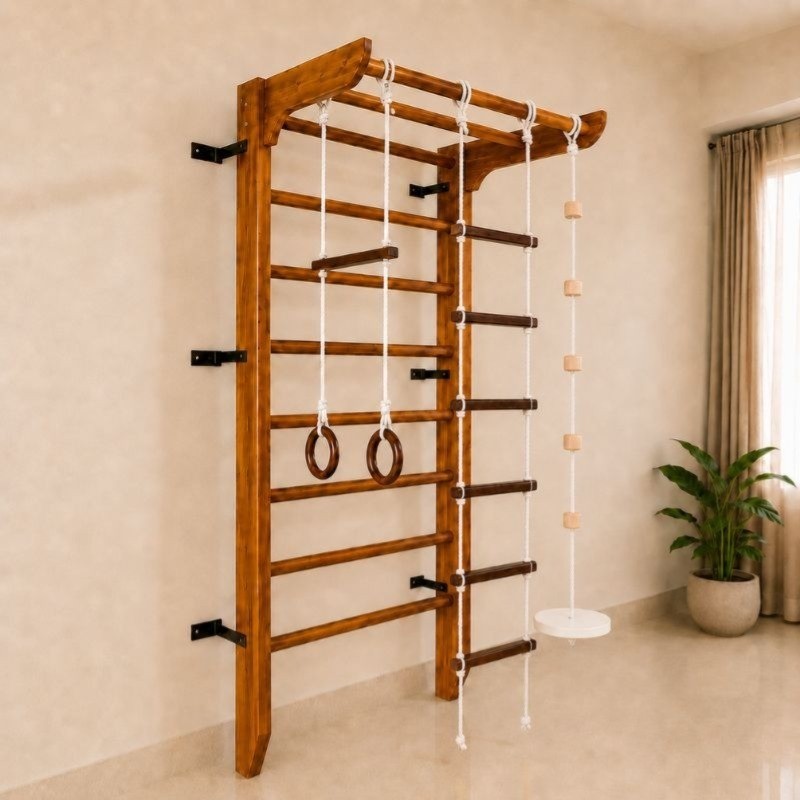
1. Wooden Swedish Wall Bar Ladder with Pull-Up Bar, Rope Ladder, Disc Swing & Trapeze Rings — Family Activity Combo
Best for: adult fitness and kids' play from a single wall
The Wooden Swedish Wall Bar Ladder with Pull-Up Bar, Rope Ladder, Disc Swing & Trapeze Rings is the flagship recommendation for families who want one wall-mounted home gym that works for adults and children. Adults can use it for pull-ups, dead hangs, stretching, mobility drills and posture work. Children can use the rope ladder, disc swing and trapeze rings for playful movement. It proves the wood advantage across almost every factor: quiet, rust-free, space-saving, furniture-quality and family-friendly. For anyone searching for a Swedish wall bar in India, a wooden pull-up bar, or a wall-mounted home gym, this is the most complete option.
View the Swedish Wall Bar Family Combo →
2. Natural Curved Wooden Balance Board for Kids – Wobble Rocker / Kinderboard

Best for: toddlers and young children, floor-based balance play
The Natural Curved Wooden Balance Board for Kids – Wobble Rocker / Kinderboard is the starting point for families with young children. This simple 40×27 inch curved solid wood board helps build balance, core control and confidence through open-ended play. It has no metal edges, no loud moving parts and no fixed way to use it. Kids can rock, balance, sit, slide toys, or turn it into a bridge during pretend play. For parents searching for a balance board for kids in India, this is an easy first step into wooden fitness equipment.
View the Wooden Balance Board for Kids →
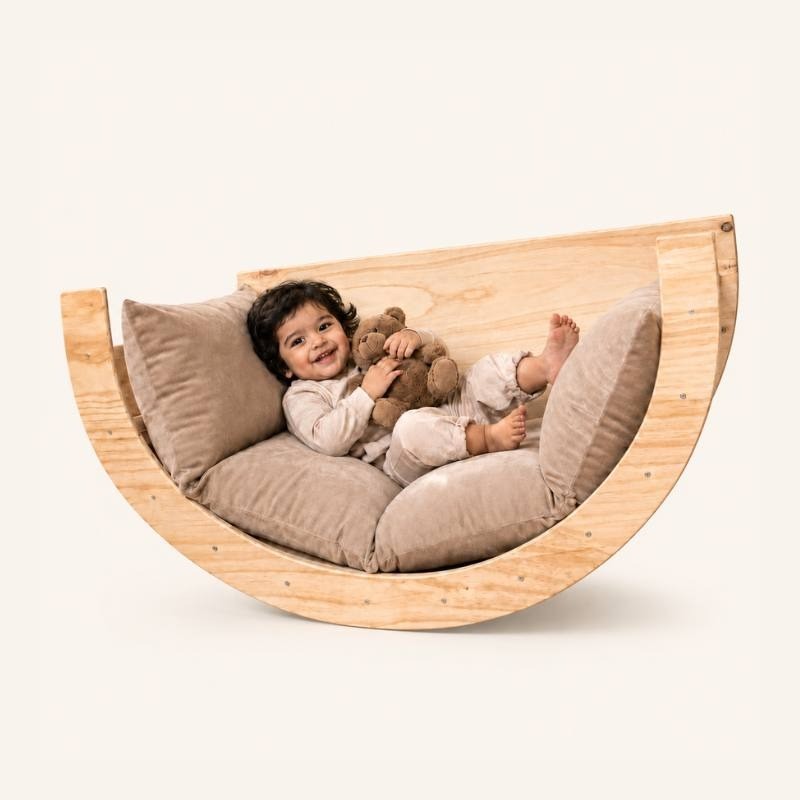
3. Natural Wood 5-in-1 Montessori Climbing Arch Rocker for Kids
Best for: children aged 1–6, versatile indoor play
The Natural Wood 5-in-1 Montessori Climbing Arch Rocker for Kids is where the wood advantage meets Montessori design. It works as a climbing arch, rocker, tunnel, slide base and storage-style play unit, giving five uses from one solid wooden piece. For young children, it supports gross motor development, sensory play and independent movement. It also looks warm enough to keep in a living room or kids’ room. For parents comparing a Montessori climbing arch in India or a wooden arch rocker, this is one of the most versatile wooden play investments.
View the 5-in-1 Montessori Climbing Arch Rocker →
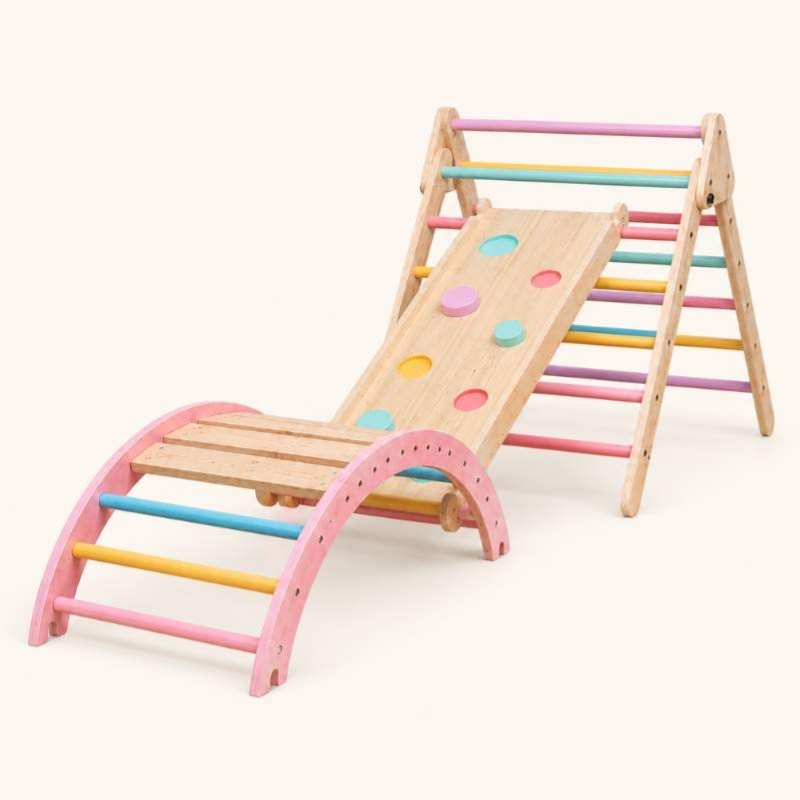
4. Montessori Pikler Climbing Playset – Climbing Arch, Pikler Triangle & Slider
Best for: complete Montessori movement setup, children aged 6 months to 6 years
The Montessori Pikler Climbing Playset – Climbing Arch, Pikler Triangle & Slider is the full child-led movement circuit. It includes an arch, Pikler triangle and slider, made using steam beech wood and HDHMR MDF. Unlike a standard climbing frame, a Pikler setup encourages children to explore movement at their own pace — climbing, balancing, sliding and crawling without forced instruction. For parents searching for a Pikler triangle in India, a Montessori Pikler set, or a wooden climbing triangle for toddlers, this is the most complete indoor movement setup.
View the Pikler Climbing Playset →
5. Natural Wood Multi-Shape Convertible Montessori Climbing Frame for Kids
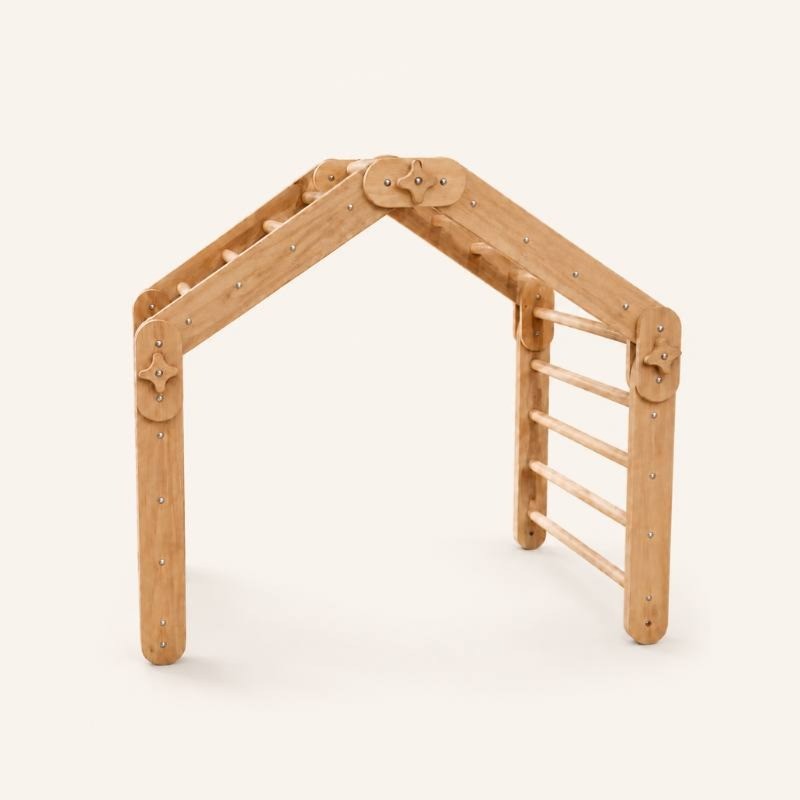
Best for: growing children, families wanting one setup that adapts over time
The Natural Wood Multi-Shape Convertible Montessori Climbing Frame for Kids is the best long-term choice for families who want one product that adapts as their child grows. It can convert into multiple play shapes such as a tunnel, ramp, bridge, climbing wall and open movement frame. That flexibility keeps the equipment useful beyond a single age stage. Instead of buying a fixed climbing toy that children outgrow quickly, this convertible Montessori climbing frame gives changing play value over time. It is ideal for parents looking for a multi-shape climbing frame in India.
View the Multi-Shape Convertible Climbing Frame →
How To Care For Wooden Home Gym And Play Equipment
The most common objection to wooden gym equipment is that it requires more maintenance than metal. In practice, the routine is simpler than anti-rust maintenance for metal, and takes less time.
For solid wood gym equipment and wooden play structures, the routine is:
- Daily or after each use: Wipe down with a soft dry cloth. If used outdoors or on a balcony, bring any rope accessories indoors if rain is expected.
- Weekly: Check all screws, bolts, wall brackets, and joint connections for tightness. Wooden structures that are used actively daily can develop minor loosening at fasteners over time — catching this in a weekly check takes thirty seconds per connection point.
- Monthly: Inspect ropes, knots, S-hooks, and ring connections on any hanging accessories for fraying, wear, or loosening. This is the same check recommended for any rope-based play equipment regardless of material.
- Once or twice a year: Apply a thin coat of natural wood oil (coconut oil, linseed oil, or a dedicated wood conditioner) to bare or lightly finished wooden surfaces. This takes under ten minutes per product and maintains the wood's natural moisture balance.
Avoid harsh chemical cleaners, abrasive scrubbers, and prolonged exposure to standing water. These are the same basic precautions that apply to any quality wooden furniture.
The honest comparison with metal: a well-maintained solid wood frame requires the above routine. A well-maintained metal frame requires regular anti-rust treatment at joints and fasteners, repainting or recoating where the finish chips, and replacement of any fasteners that show corrosion. In humid Indian climates, the metal maintenance routine is more demanding, not less.
Author Bio
Written by the Woodensure Editorial Team.
All Woodensure fitness and play products are manufactured at our workshop in Udaipur, Rajasthan, from solid natural wood. Free shipping across India. For installation guidance, customisation enquiries, or product questions, contact our team on WhatsApp.