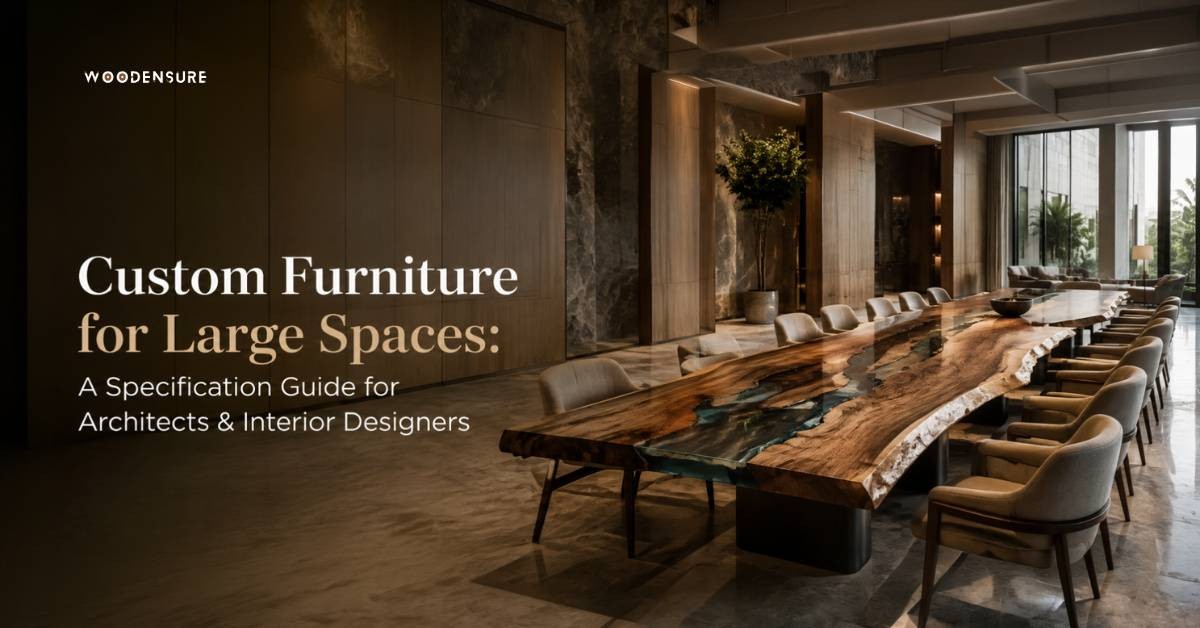
Custom Furniture for Large Spaces: A Specification Guide for Architects & Interior Designers
Large-format custom furniture cannot be specified by simply taking a standard product and making it longer. Once a dining table, boardroom table, lobby piece or statement console moves beyond common catalogue dimensions, material availability, structural support, base placement, weight, transport, site access and installation all become part of the specification.
This guide explains what to define when specifying custom furniture for boardrooms, hotel lobbies, luxury villas and other large interior spaces, including requirements for 8 ft, 9 ft, 10 ft and larger pieces.
Last Updated - 12 Aug 2026
What Is Large-Format Custom Furniture?
Large-format custom furniture refers to pieces designed beyond standard catalogue dimensions or proportions and manufactured specifically for a project, space and use case. It can include 8–12+ ft conference tables, oversized dining tables, hotel lobby tables, reception furniture, communal tables, long consoles, benches and statement furniture for villas or hospitality projects.
As furniture becomes longer, wider or heavier, the design usually needs to be reconsidered for material selection, support, movement, assembly and installation. A large piece should therefore be treated as a project-specific product rather than an enlarged version of a standard design.
Why Standard Furniture Specifications Fail in Large Spaces
Standard furniture specifications often fail when designers scale up a catalogue product without reviewing how the change affects construction and use.
A longer tabletop may need different support spacing. A heavier top may require a revised base. A wider table may create poor chair clearance. A large one-piece product may also become impossible to move through a lift, staircase, corridor or doorway.
Common problems include:
- Insufficient structural support
- Incorrect tabletop thickness
- Poor base positioning
- Inadequate seating or knee clearance
- Unsuitable slab or material selection
- Inconsistent finish expectations
- Transport limitations
- Site-access problems
- Installation requirements being considered too late
An 8-ft design cannot always become a 10-ft or 12-ft design simply by increasing its length. The larger the furniture becomes, the more important it is to review the product as a complete system: top, base, weight, usage, transport and installation.
What Changes When Furniture Reaches 8 ft, 9 ft, 10 ft or Larger?
Large dimensions affect several parts of the specification at the same time.
Material Availability
For solid wood and live-edge furniture, the intended dimensions need to be matched with suitable timber or slab availability. Designers should consider wood width, grain direction, edge profile, natural variation and the visual continuity expected across the finished piece.
For wood-and-epoxy furniture, the relationship between timber and resin should also be defined early. A large epoxy table is not only about selecting a colour; the proportion of wood, resin flow, edge treatment and final visual balance all influence the outcome.
Structural Support
As the span increases, tabletop thickness, base spacing, understructure and weight distribution become more important. A visually attractive base can still be unsuitable if it reduces stability or interferes with seating.
Transportation
Large furniture can create logistical constraints. The manufacturer may need to evaluate whether the piece should travel fully assembled, partially assembled or in modular form.
Site Access
Architects should check the actual route from unloading point to final placement, including doorway widths, lift dimensions, staircase turns, corridor widths and installation space.
Can a Custom Table Be Made Longer Than 10 ft?
Yes. Tables can be manufactured beyond 10 ft when the design, raw material, support system, transport method and site conditions are evaluated together. The practical solution depends on the project rather than on length alone.
Large Furniture Specification Checklist for Architects & Interior Designers
A clear furniture schedule reduces avoidable revisions during manufacturing. For every oversized piece, define the following before production:
| Specification | What to Define |
|---|---|
| Overall dimensions | Length × width × height |
| Material | Solid wood, epoxy, or combination |
| Top thickness | Finished thickness |
| Edge profile | Straight, live edge, beveled, or custom |
| Finish | Matte, satin, natural, or approved sample |
| Base material | Wood, metal, or custom |
| Base design | U, X, pedestal, frame, or project-specific |
| Base position | Exact spacing from edges |
| Seating | Number of intended users |
| Cable management | Required or not required |
| Assembly | One-piece, knock-down, or modular |
| Site access | Lift, doorway, staircase, corridor |
| Quantity | Prototype and total project quantity |
| Delivery | Project location and target date |
The specification should also include reference drawings or approved visual references wherever possible. For high-value projects, the design team and manufacturer should resolve unclear details before the furniture goes into production.
How to Specify a Boardroom or Conference Table
A boardroom table should be specified around people, technology and circulation—not only around room size.
Start with the required seating capacity. From there, define the overall length and width, chair spacing, end seating and movement around the table. Base positions should be checked against legroom so that structural support does not interfere with users.
Technology should also be resolved before production. If the table requires cable ports, power access, data points, charging modules or concealed wiring, these should be shown in the furniture drawing rather than added as an afterthought.
For a 10-ft boardroom table, the design team should ideally provide:
- Final dimensions
- Required seating capacity
- Cable-management requirement
- Top material and finish
- Base design and position
- Room layout
- Site-access information
This makes it easier to assess the table as both a furniture product and part of the meeting-room infrastructure.
Specifying Custom Furniture for Hotel Lobbies & Large Villas
Hotel lobbies and large villas both require furniture that feels proportionate to the architecture, but the performance requirements can differ.
In hotel lobbies, high-traffic use, cleaning, durability and maintenance should be considered alongside visual impact. Large centre tables, communal tables, consoles and reception-related pieces should support guest movement rather than obstruct it. Edges, finishes and base positions should be reviewed with circulation in mind.
In large villas, the challenge is often scale. Double-height spaces, open-plan living areas and generous dining rooms can make standard furniture look undersized. Custom 10–12 seater dining tables, oversized live-edge tables, consoles, coffee tables and benches can be designed to suit the proportions of the room.
In both cases, “larger” should not mean “oversized for effect.” The furniture should relate to room dimensions, intended use, circulation and the overall interior concept.
Looking for Custom Solid Wood Furniture for Your Hotel or Resort Project?
Partner with Woodensure for handcrafted, durable, and premium solid wood furniture tailored specifically for commercial bulk orders.
Solid Wood vs Epoxy for Oversized Furniture
Both solid wood and wood-and-epoxy can work well for large-format furniture. The right choice depends on the visual brief, material availability and intended application.
| Factor | Solid Wood | Wood + Epoxy |
|---|---|---|
| Visual character | Natural grain-led | More expressive and customized |
| Colour flexibility | Limited to wood and finish | High through resin colour |
| Live-edge use | Suitable | Especially suitable |
| Large formats | Depends on suitable timber | Offers additional design flexibility |
| Typical applications | Villas, hotels, boardrooms | Villas, hotels, boardrooms |
Solid wood is often preferred when the design calls for a restrained, natural or timeless appearance. Epoxy is useful when the furniture is intended to become a stronger visual feature.
The specification should be based on the project concept rather than on trend alone.
Read more: Epoxy Resin Design: Colors, Techniques, Textures & Trends
Case Study: Manufacturing a 9-ft Custom Epoxy Table
A useful way to understand large-format customization is to look at an actual project scale. Woodensure has manufactured a 9-ft epoxy table, demonstrating that requirements beyond conventional retail dimensions can be produced when the project is planned around the material, construction and delivery conditions.
For a table of this size, the specification needs to address more than the final length. The wood selection, epoxy design, finished top thickness, base placement, finish and transportation method all need to work together.
A reference image may establish the visual direction, but the manufacturing specification must translate that concept into dimensions, materials and buildable details.
Can the Same Concept Be Produced at 10 ft or Larger?
Potentially, yes. Larger sizes can be evaluated based on raw-material availability, structural requirements, design intent, transport method and site conditions. The final solution should be confirmed project by project.
One-Piece vs Modular Construction
One-piece construction can provide visual continuity and may be suitable when transport and access are straightforward.
Modular or knock-down construction can be more practical when the furniture must pass through restricted doors, lifts, staircases or corridors. It can also simplify transport and on-site handling.
The choice should be made before production, not after the product reaches site. Architects should therefore share access constraints with the manufacturer at the specification stage so that joinery, base connections and assembly requirements can be planned correctly.
What Should Architects Send Before Requesting a Quote?
The more complete the project brief, the more accurately a manufacturer can assess feasibility and quotation.
Ideally, send:
- Furniture drawing or sketch
- BOQ or furniture schedule
- Final L × W × H dimensions
- Required quantity
- Material preference
- Finish reference or sample
- Reference images
- Base design
- Project location
- Required delivery date
- Site-access information
- Installation requirements
For non-standard dimensions, it is useful to involve the manufacturer before the design is fully frozen. Early feasibility feedback can help avoid changes after drawings, finishes and layouts have already been approved.
If you already have a BOQ, drawing set or furniture schedule, share it with Woodensure for project-specific evaluation before finalizing the furniture specification.
Common Mistakes When Specifying Large Custom Furniture
Large furniture projects often become difficult because one practical detail is missed early.
Common mistakes include:
- Scaling a standard design without reviewing support
- Checking site access only after manufacturing
- Finalizing the tabletop before the base
- Ignoring total product weight
- Forgetting seating and knee clearance
- Not approving material or finish references
- Overlooking transport limitations
- Specifying cable management too late
- Freezing drawings before manufacturing feasibility is reviewed
The best specification is not the one with the most details. It is the one that resolves the details that affect how the furniture will be manufactured, moved, installed and used.
Planning furniture beyond standard dimensions?
Share your drawings, BOQ, furniture schedule or required dimensions with Woodensure to evaluate custom furniture for boardrooms, hospitality spaces, luxury villas and other large interior projects.
Author Bio:
The Woodensure team works closely with architects, interior designers, hospitality professionals, and project teams on custom solid wood and epoxy furniture requirements across India. With hands-on experience in large-format tables, project-specific dimensions, material selection, structural planning, and custom manufacturing, the team shares practical insights to help design professionals specify furniture that is both visually aligned and technically feasible.