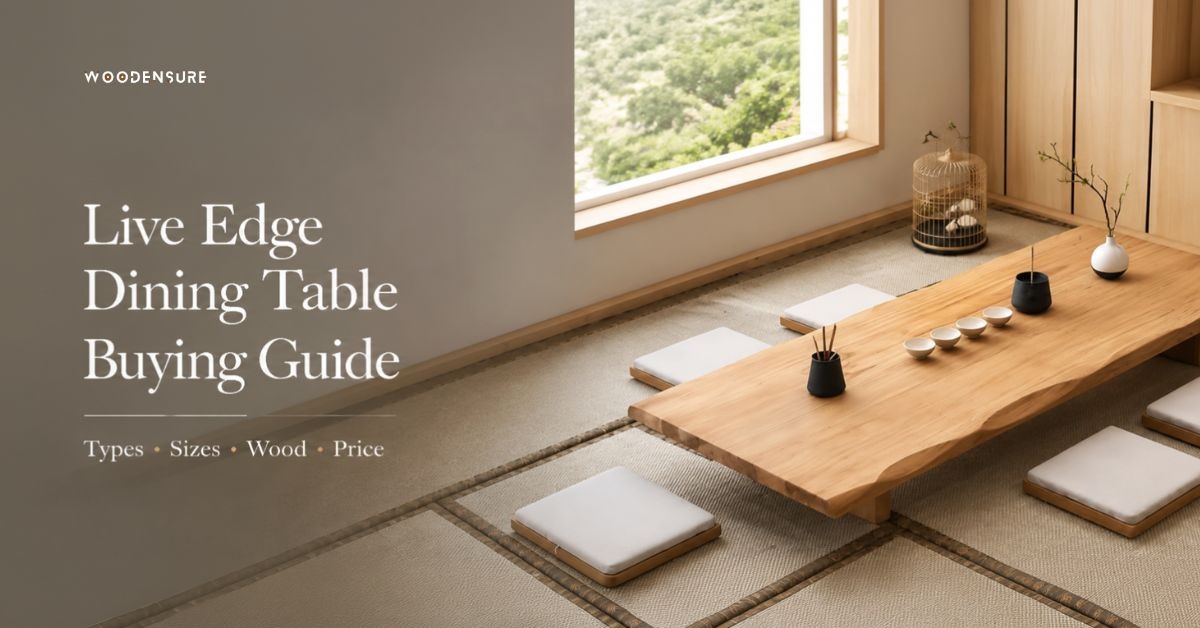

Live Edge Dining Table Buying Guide India: Types, Sizes, Wood, Price & How to Choose
A live edge dining table is made from solid wood while preserving the tree slab’s natural outer contour instead of cutting it perfectly straight. In India, live edge dining tables are available from compact 4-seater sizes to 8-seater and custom formats. Prices vary by wood, size, thickness, base, finish and epoxy work, with Acacia among the most popular choices.
If you are looking for a live edge dining table in India, this guide explains the different types, ideal sizes, wood species, finishes, prices, maintenance requirements and how to choose the right table for your home.
Last Updated: 22 August 2026
What Is a Live Edge Dining Table — and What Makes It Different From a Regular Dining Table?
When a tree trunk is milled into slabs, furniture manufacturers normally trim away the irregular outer edge to create a perfectly straight tabletop.
A live edge table does the opposite.
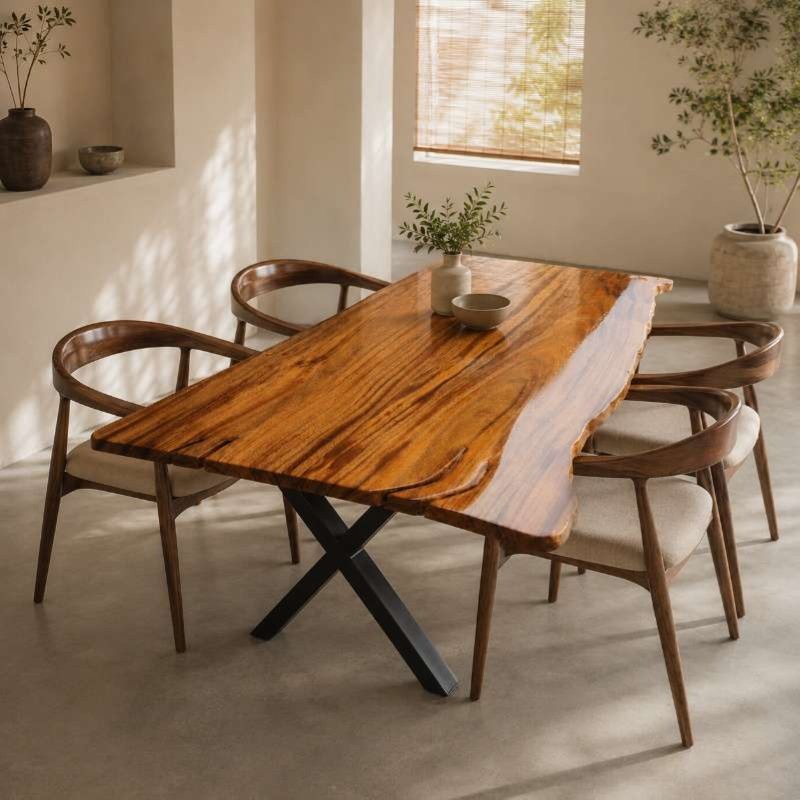
The natural contour of the slab is intentionally preserved, allowing the tabletop to retain the curves and variations created by the original tree.
This means a live edge dining table may show:
- Natural curves along the slab
- Visible knots and grain variation
- Differences between heartwood and sapwood
- Small natural cracks or filled voids
- Variations in colour and edge profile
These characteristics are considered part of the design rather than manufacturing defects.
Why is every live edge table different?
Every tree grows differently. Grain direction, knots, colour, width and the shape of the trunk vary from one slab to another.
As a result, even if two live edge tables are manufactured in the same dimensions and finish, their natural grain and edge profiles will never be completely identical.
That individuality is one of the main reasons live edge furniture has become popular in premium Indian homes, villas, cafés and design-led interiors.
Woodensure's current live edge collection includes more than 20 designs ranging from natural wood tables to bench sets, wooden-leg designs, organic shapes and epoxy-enhanced tables.
Types of Live Edge Dining Tables — Which Style Suits Your Home?
1. Pure Solid Wood Live Edge Dining Table
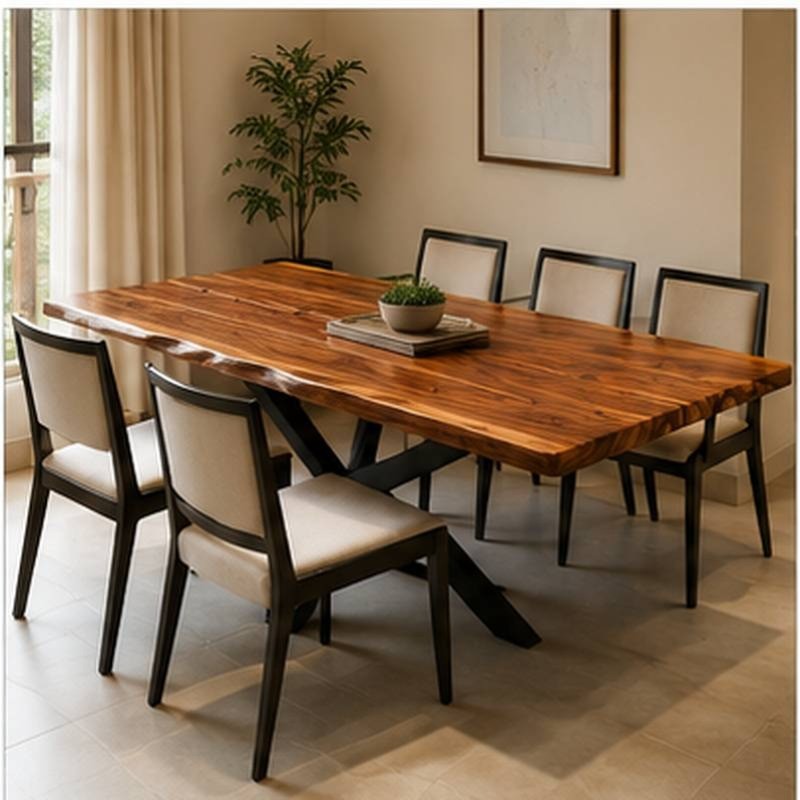
This is the most natural interpretation of live edge furniture.
The tabletop is primarily solid hardwood, with the organic edges, grain and natural colour becoming the main design feature. There is little or no decorative resin competing with the wood.
Best for: Rustic, farmhouse, Japandi, Scandinavian, organic-modern and nature-inspired interiors.
Choose this style when you want the wood itself to be the centrepiece.
Examples in the Woodensure range include natural-grain live edge tables, Raw Wood Edge designs, handcrafted farmhouse tables and Acacia live edge variants.
2. Live Edge Table With Minimal Epoxy
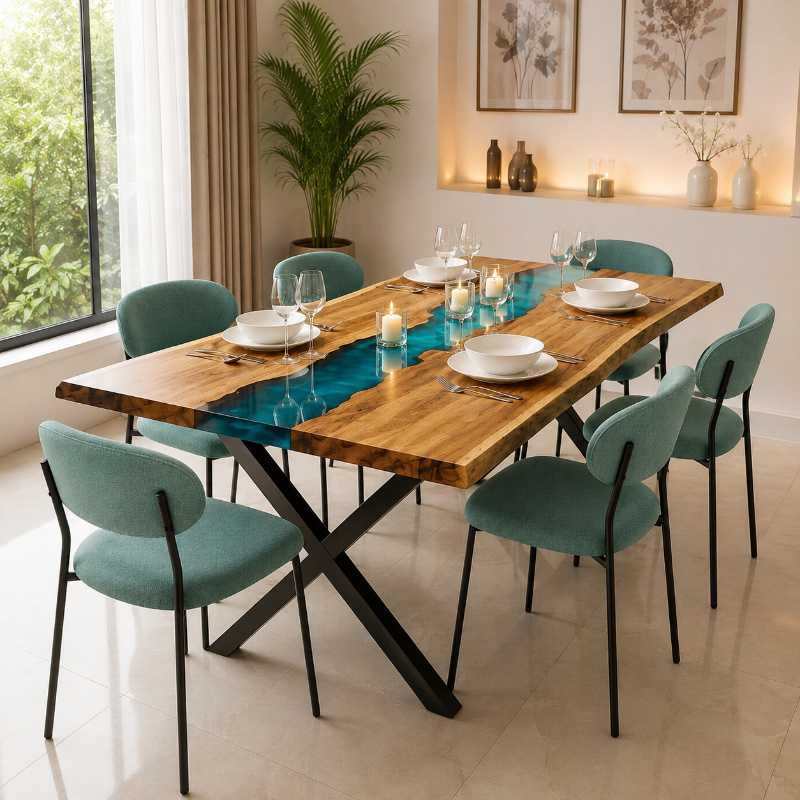
Some natural slabs contain cracks, knots or voids that can be stabilised or highlighted using a small quantity of epoxy resin.
Unlike a river table, resin does not dominate the design. It complements the timber while preserving the appearance of a mostly natural wooden table.
Best for: Buyers who like solid wood but want subtle contemporary detailing.
This approach works particularly well on larger slabs where natural cracks and voids are part of the slab's character.
3. Live Edge Epoxy River Dining Table
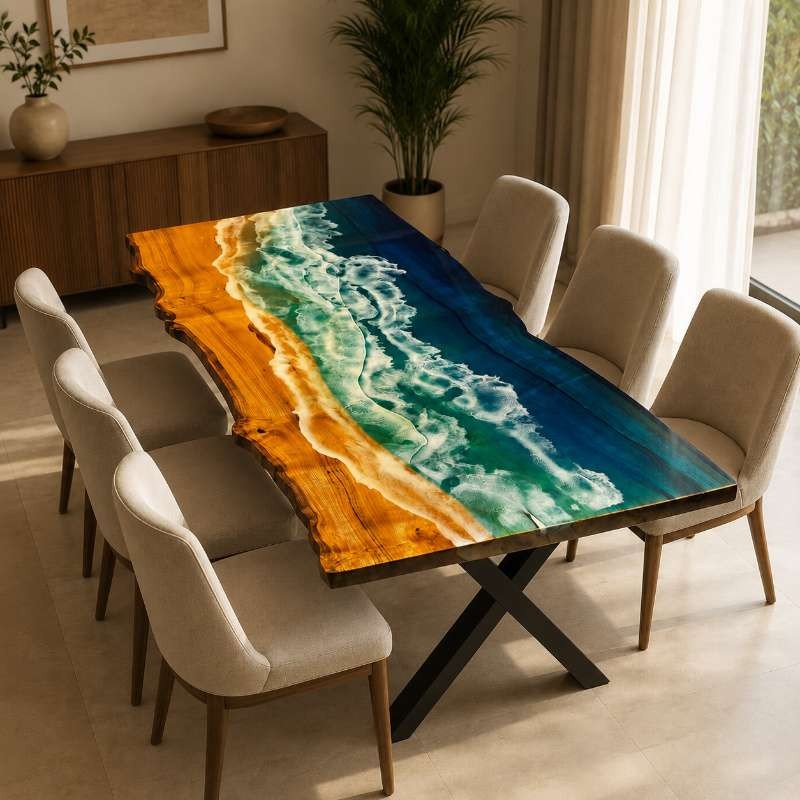
A live edge epoxy river table usually positions natural-edged wood sections around a coloured or transparent epoxy channel.
Here, both materials become equally important visually.
Blue, teal, black, white and transparent resin can transform the dining table into a strong statement piece.
Best for: Contemporary homes, luxury apartments, villas and interiors where the dining table needs to become a focal point.
For a deeper explanation of resin types, colours, sizes and pricing, read the Epoxy Resin Dining Table Buying Guide.
4. Live Edge Dining Set With Bench or Chairs
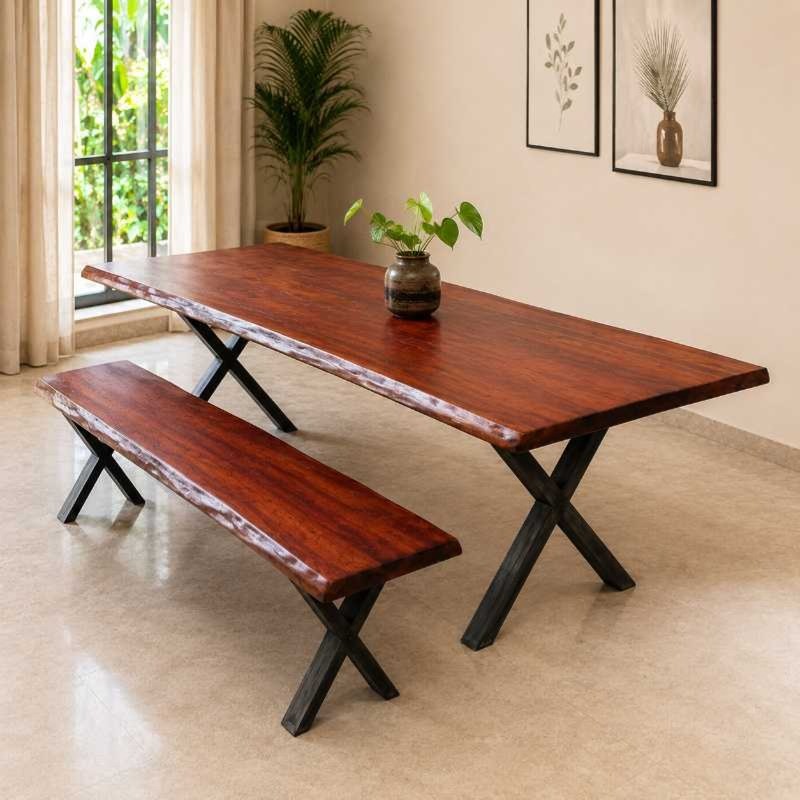
A live edge table can also be purchased as a complete dining arrangement with matching chairs, a bench, or a combination of both.
Benches work particularly well with live edge furniture because the long horizontal wooden surface visually complements the natural table slab.
Best for: Family dining spaces, farmhouse interiors and buyers who want a coordinated dining setup instead of sourcing chairs separately.
Live Edge Dining Table Shapes — Which Shape Suits Your Dining Room?
| Shape | Best For | Typical Seating | Interior Style |
|---|---|---|---|
| Rectangular | Most Indian dining rooms | 4–8+ | Rustic, modern, farmhouse, Japandi |
| Square | Square dining rooms and compact layouts | 4 | Modern, contemporary, minimalist |
| Oval | Better circulation and softer corners | 4–6 | Scandinavian, modern, transitional |
| Freeform / Organic | Statement interiors | Varies | Artistic, bohemian, nature-inspired |
For most homes, a rectangular live edge table is the safest choice because the natural slab edge can run along the complete length of the tabletop.
An oval or freeform design makes more sense when visual softness and sculptural character are more important than conventional geometry.
Live Edge Dining Table Sizes — 4 to 8 Seater Guide
| Seating | Recommended Table Size | Typical Top Thickness | Suggested Room |
|---|---|---|---|
| 4 Seater | Approx. 1,200 × 900 mm | 1.15–1.5 in | 9 × 9 ft+ |
| 6 Seater | 1,500–1,800 × 900 mm | 1.15–1.5 in | 10 × 10 ft+ |
| 6–8 Seater | 1,800–2,100 × 900–1,000 mm | 1.15–1.5 in | 12 × 10 ft+ |
| 8 Seater | 2,100–2,400 × 900–1,000 mm | 1.15–1.5 in | 12 × 10 ft+ |
| Custom | Made to requirement | Custom | Villas and large spaces |
Simple dining-table sizing rule
Allow roughly 600 mm of table edge per person and ideally around 900 mm of circulation space around the table for pulling chairs out comfortably.
For example, a 1,800 mm × 900 mm six-seater with 900 mm circulation around it works most comfortably in a dining zone of approximately 3,600 × 2,700 mm.
Always measure your room before choosing the table rather than deciding only by seater count.
Wood Species for Live Edge Dining Tables in India
Choosing the right timber is especially important in live edge furniture because the wood grain remains one of the strongest visual features.
| Wood | Character | Typical Colour | Best For |
|---|---|---|---|
| Acacia | Bold, varied natural grain | Golden brown to warm amber | Indian homes, everyday dining |
| Walnut | Fine, sophisticated grain | Chocolate to dark brown | Luxury interiors |
| Mango Wood | Distinctive grain and variation | Honey to medium brown | Natural and sustainable interiors |
| Sheesham | Rich visible grain | Medium to deep brown | Traditional and contemporary Indian interiors |
Why Acacia Works Particularly Well for Live Edge Tables
Acacia is widely used across Woodensure's live edge collection because it combines strength with distinctive grain.
Its warm colour works well with neutral Indian interiors, stone flooring, beige upholstery, black metal, rattan and natural fabrics.
Acacia is also a dense hardwood and, when properly seasoned and finished, performs well for everyday dining furniture.
Exact hardness varies between Acacia species, so buyers should focus on timber quality, seasoning, slab selection and construction instead of relying only on a single hardness number.
Base and Leg Options for Live Edge Dining Tables
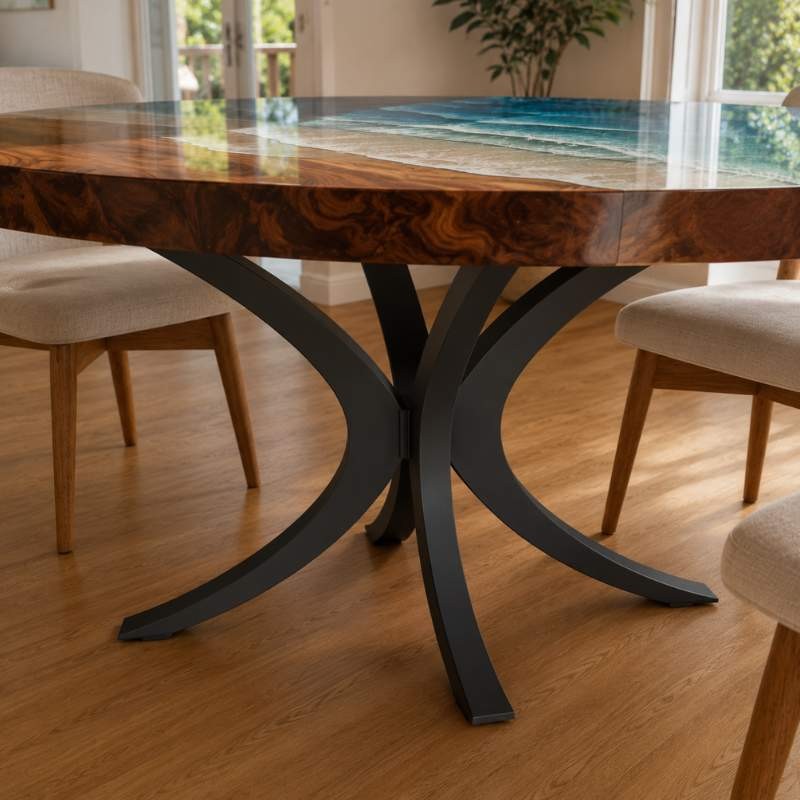
Black Powder-Coated Metal Legs
Metal frames are one of the most popular combinations with live edge wood.
The dark geometric base creates contrast against the irregular natural slab and suits modern, industrial and contemporary homes.
Metal bases are also dimensionally stable and work especially well on longer dining tables.
Solid Wood Legs
Wooden legs create a warmer, completely natural appearance.
Woodensure's Earthy Elegance Live Edge Dining Table, for example, combines solid Acacia wood with wooden legs and is available in multiple lengths.
This style works particularly well in farmhouse, rustic, Japandi and timber-heavy interiors.
Pedestal, Trestle and Custom Bases
For larger custom tables, a pedestal or trestle arrangement may improve legroom and support.
Base positioning becomes increasingly important on long 8-seater and oversized tables because insufficient support can affect stability.
Natural, Semi-Gloss or Glossy — Which Finish Should You Choose?
Natural or Oil Finish
Oil penetrates the timber rather than creating a thick surface layer.
It preserves the tactile, natural character of the wood and is relatively easy to refresh or repair.
However, it requires more periodic maintenance.
Semi-Gloss Finish
For most Indian homes, semi-gloss offers a practical middle ground.
It gives the surface better protection against everyday spills while allowing the wood grain to remain natural rather than highly reflective.
High-Gloss Finish
Gloss creates maximum depth and visual richness in the timber.
It works especially well on dramatic statement pieces but can reveal fingerprints, dust and fine surface marks more easily.
Recommendation: For a dining table that will be used every day, semi-gloss is usually the most balanced option.
Who Should Buy a Live Edge Dining Table?
Choose live edge if:
- You want a dining table that cannot look exactly like anyone else's.
- You prefer real wood grain over artificial uniformity.
- Your interiors are rustic, modern-organic, farmhouse, Japandi or nature-inspired.
- You want solid wood furniture that can potentially be restored or refinished.
- You prefer natural materials and visible craftsmanship.
- You need custom dimensions for a specific dining room.
Consider another material if:
- You want perfectly straight, identical edges.
- You prefer dramatic resin colours rather than natural timber character.
- Your budget is closer to entry-level engineered wood furniture.
- You want an extremely lightweight table.
- You need an instantly available customised piece.
If stronger colour and artistic detailing are priorities, compare live edge wood with an epoxy resin dining table.
If you are choosing between natural wood and a premium stone surface, also read Marble vs Solid Wood Dining Table.
Woodensure Live Edge Dining Tables — Styles and Current Options
Woodensure's live edge category currently contains well over 12 dining-table variants. Some notable options include:
- Raw Wood Edge Dining Table — an accessible natural live edge design.
- Natural Grains Live Edge Dining Table With Metal Legs — natural tabletop with contemporary black base.
- Live Edge Dining Table With Epoxy Design — combines organic wood with decorative resin.
- Raw Live Edge 6-Seater Dining Table With Metal Legs — suited to standard family dining rooms.
- Rustic Live Edge Dining Table With Bench — useful for relaxed family-style seating.
- Live Edge Acacia Wood Dining Table Set — complete natural wood dining arrangement.
- Live Edge Solid Wood Dining Table With Bench & Two Chairs — compact coordinated dining set.
- Hazel Live Edge Solid Wood Dining Table With Wooden Legs — all-wood appearance.
- Earthy Elegance Live Edge Dining Table — Acacia construction with wooden legs.
- Acacia Wood Live Edge Dining Table — classic natural solid wood design.
- Handcrafted Natural Live Edge Dining Table for Modern Farmhouse Interiors — suited to warm, rustic-modern rooms.
- Premium Handmade Solid Wood Live Edge Dining Table — handmade natural-edge design.
- Live Edge Dining Table With Tree Trunk Base — more sculptural and statement-oriented.
- Live Edge Wood Oval Shape Epoxy Dining Table — premium organic oval format with epoxy.
- Acacia Wood Live Edge Dining Table With Epoxy — combines Acacia grain with resin detailing.
Live edge dining table price in India
As of August 2026, Woodensure's live-edge category has listed designs beginning at approximately ₹18,400, while larger and more complex live-edge epoxy designs can reach approximately ₹99,000.
For buyers specifically researching live edge dining table 6 seater price in India, many Acacia and live-edge designs fall within the mid-range depending on length, tabletop thickness, base construction and whether chairs, benches or epoxy work are included.
Prices change by size and configuration, so compare the final selected size rather than relying only on the category starting price.
How to Care for a Live Edge Dining Table
A well-made solid wood table is designed for long-term use, but proper maintenance helps preserve its colour and stability.
Daily cleaning
Use a soft, slightly damp cloth and dry the surface afterwards. Never allow standing water to remain on the table or natural edge.
Oil-finished tables
If your table uses an oil finish, periodic re-oiling helps prevent the surface from becoming dry and restores grain depth. Follow the manufacturer's finish-specific instructions before applying any product.
Lacquered and semi-gloss tables
These normally require less frequent maintenance. Use a soft cloth and avoid abrasive cleaners or scrubbers.
Protect against heat
Use trivets or heat-resistant mats under hot cookware instead of placing hot vessels directly on the timber.
Wipe spills quickly
Tea, coffee, oil, coloured foods and acidic liquids should be cleaned promptly.
Manage humidity
Solid wood naturally reacts to changes in humidity. Avoid positioning the table directly under strong AC airflow, immediately beside a heat source or in areas with persistent dampness.
Scratches
Minor marks on certain natural finishes can sometimes be sanded and refinished. Deeper damage or lacquer scratches are better handled professionally.
Final Buying Advice
A live edge dining table in India makes the most sense when you want the warmth and longevity of natural wood without the mass-produced appearance of a conventional dining set.
Start with three decisions: room size, wood style and base design.
For most families, a rectangular 6-seater Acacia live edge table with a semi-gloss finish and stable metal or wooden base offers a practical combination of durability, natural character and everyday usability.
Choose pure wood when you want understated natural beauty. Choose minimal epoxy when you want subtle contemporary detailing. Choose a full epoxy river design when the dining table needs to become a stronger statement piece.
Most importantly, measure your dining room before ordering. The right live edge table should not only look impressive—it should leave enough space for chairs, movement and everyday family use.
Explore the Woodensure Dining Table Buying Guide Cluster
- Shop Live Edge Dining Tables
- Read: Epoxy Resin Dining Table Buying Guide
- Read: Marble vs Solid Wood Dining Table
- Read: Epoxy Resin Furniture vs Solid Wood Furniture
Need a Custom Live Edge Dining Table?
Want a custom size, shape, finish or wood specification not listed online?
Share your dining-room dimensions, required seating capacity and interior style with Woodensure on WhatsApp. The team can recommend a live edge configuration based on your available space and design requirements.
Author Bio
Written by the Woodensure craftsmanship team — manufacturers of custom live edge, epoxy resin and solid wood dining tables in Udaipur, Rajasthan, supplying handcrafted furniture to homes and projects across India.