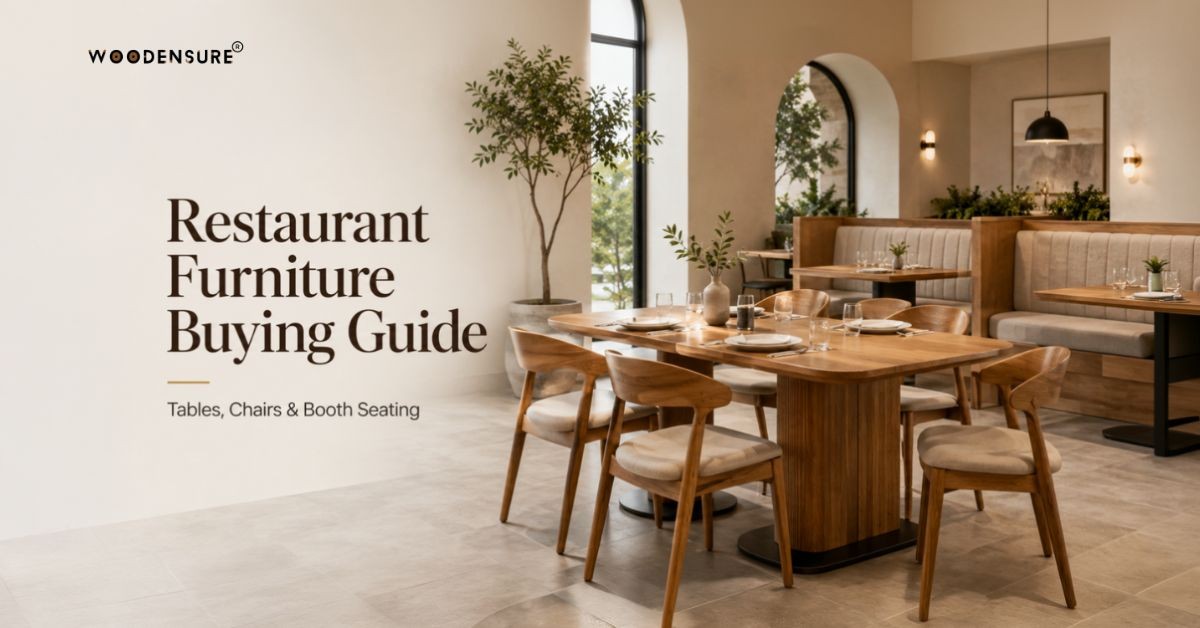
Restaurant Furniture Buying Guide: How to Choose Tables, Chairs & Booth Seating
Choosing restaurant furniture in India involves three decisions: table material and dimensions, chair comfort and durability, and the right seating format for your floor plan. Standard dining chairs generally need a 45–48 cm seat height for 72–76 cm tables, while booth or bench seating can improve perimeter-space use. Woodensure manufactures custom bulk restaurant furniture in Udaipur with pan-India supply.
For B2B buyers, furniture affects covers, staff movement, cleaning time, maintenance and brand consistency—not only appearance. This restaurant furniture buying guide explains how to specify tables, chairs and booth seating for restaurants, cafés, bars, QSRs and rooftop dining spaces.
Last Updated: July 2026
Why Restaurant Furniture Is Different from Home Furniture

Commercial furniture is moved, loaded, cleaned and reused continuously. Its joints, frame, glides, upholstery and finish therefore need to withstand high-cycle, non-domestic use. Surfaces must also tolerate food spills, moisture, warm serving dishes and frequent wiping.
B2B buyers should calculate cost per cover, not only the price of each table or chair:
Cost per cover = Total furniture investment ÷ Total usable seats
A cheaper chair that needs repeated repairs may cost more over time than a better-built chair with serviceable joints and replaceable glides. Ask suppliers for a declared user-weight rating or relevant test report. Recognised non-domestic seating standards include EN 16139 and ANSI/BIFMA X5.4, where applicable.
Woodensure manufactures made-to-order hospitality furniture rather than reselling a fixed catalogue, allowing buyers to specify dimensions, wood, finish, upholstery and seating format.
Planning a new outlet? Share your floor plan and target seating capacity with Woodensure for a bulk quote.
How to Choose the Right Dining Tables for Your Restaurant
Start with your menu, tableware and average group size. A coffee shop serving beverages and snacks needs less tabletop depth than a family restaurant serving shared dishes, thalis and multiple bowls.
Standard Restaurant Table Dimensions

Use these measurements as planning starting points, then test them with your actual plates, glasses and serving ware.
| Seating Capacity | Practical Starting Size |
|---|---|
| 2 covers | 60 × 60 cm square or 60–70 cm round |
| 4 covers | 75–90 × 75–90 cm square or approximately 90 cm round |
| 6 covers | 150–180 × 75–90 cm rectangular |
| Standard dining-table height | 72–76 cm |
| Bar or high-table height | 90–105 cm |
Allow approximately 60 cm between table edges only in lightly trafficked sections. Main service routes generally need more clearance. Around 90 cm is a useful planning benchmark, subject to the architect’s layout and applicable Indian building, fire and accessibility requirements.
Accessible-route guidance in major international standards commonly uses approximately 915 mm of clear width, although the local rules applicable to your project must always take priority.
Best Table Materials for Restaurants

| Material | Commercial Performance | Maintenance | Best Suited To |
|---|---|---|---|
| Solid hardwood | Strong, repairable, and refinishable | Daily wiping and periodic finish inspection | Fine dining, cafés, and family restaurants |
| Epoxy resin with wood | Good stain resistance and distinctive appearance | Non-abrasive cleaning and protection from extreme heat | Premium cafés, bars, and concept dining |
| Live-edge hardwood | Durable statement surface with natural character | Periodic finish inspection or oiling | Boutique and destination restaurants |
| Resin or compact top with metal base | Moisture-tolerant and easy to clean | Low maintenance | Rooftops, outdoor cafés, and QSRs |
| Low-grade MDF | Vulnerable at exposed edges and in wet areas | May require early replacement | Not preferred for high-moisture areas |
Solid hardwood is often a balanced commercial choice because surface wear and scratches can usually be repaired. Sheesham, Teak, Acacia and Mango wood can be considered depending on the design, budget, finish and exposure conditions.
Epoxy-and-wood tables suit restaurants that need a strong visual statement, while resin or compact surfaces can be practical in outdoor and high-spill environments.
Compare the options in Woodensure’s solid wood vs epoxy resin furniture guide and marble vs solid wood dining-table guide.
Restaurant Table Bases and Leg Options

A metal pedestal base provides more legroom and simplifies floor cleaning, especially for two- and four-cover tables.
Four-leg or twin-pedestal metal frames are generally better suited to larger tabletops where the weight must be distributed across a wider surface. Solid-wood legs create a premium appearance but require careful joint, legroom and floor-clearance planning.
Always specify adjustable levelling feet. Restaurant floors are rarely perfectly level, and a stable base prevents wobbling without using folded paper or cardboard beneath the legs.
Need custom restaurant table dimensions?
Request a bulk manufacturing quote from Woodensure.
How to Choose Restaurant Chairs That Last
Evaluate chairs together with the intended restaurant table. Check the seat height, compressed cushion height, table apron, armrest clearance and table-base position before approving the design.
Restaurant Chair Specifications That Matter

- Seat height: 45–48 cm for most 72–76 cm dining tables.
- Seat depth: Approximately 42–46 cm.
- Seat-to-table clearance: Generally 25–30 cm from the seat surface to the underside of the tabletop.
- Load requirement: Request a declared rating or recognised test report rather than relying only on the term “heavy duty.”
- Floor glides: Choose replaceable glides compatible with tile, stone, concrete or wooden flooring.
- Backrest: Match the support and height to the expected dining duration.
- Chair width: Ensure multiple chairs can fit without touching one another or obstructing the table base.
Commercial guidance commonly pairs an approximately 46 cm dining-chair seat with a standard dining table and recommends roughly 25–30 cm between the seat and the underside of the table.
Chair Type by Restaurant Concept

| Restaurant Concept | Recommended Chair | Main Specification |
|---|---|---|
| Fine dining | Upholstered high-back chair or armchair | Comfort for longer dining occasions |
| Casual dining | Solid-wood armless chair | Durability and easy cleaning |
| Café or coffee shop | Lightweight wooden or cane chair | Flexibility, ventilation, and visual character |
| Bar or pub | Bar stool with footrest | Correct counter-to-seat relationship |
| Rooftop or outdoor venue | Metal-frame outdoor chair | Moisture, corrosion, and UV resistance |
| QSR or food court | Stackable wood or metal chair | Fast cleaning and efficient storage |
For high tables and counters measuring 90–105 cm, stool seat heights commonly fall within approximately 65–75 cm. Confirm the final gap between the seat and counter before manufacturing.
Upholstered vs Non-Upholstered Chairs

Non-upholstered chairs are generally easier to maintain in fast-turnover restaurants. They can be wiped quickly and do not require fabric replacement after stains or tears.
Upholstered chairs offer greater comfort for fine dining and longer meals, but the selected fabric or vinyl should be suitable for commercial abrasion, regular cleaning and colour consistency.
Cane chairs provide good ventilation in warm Indian conditions and create a distinctive café appearance. The cane panel should be designed so it can be repaired or replaced without discarding the entire chair.
Read Woodensure’s complete guide to chair types.
Buying restaurant chairs in bulk? Ask Woodensure for MOQ pricing, finish samples and custom seating options.
Bench and Booth Seating: Maximising Covers per Square Foot

Bench seating uses perimeter walls efficiently and reduces the chair-pull-out movement that can obstruct narrow dining rooms. Booth seating adds privacy, acoustic separation and a stronger feeling of personal space.
The actual capacity improvement depends on room geometry, table depth, aisle width and accessibility. It should be confirmed using a scaled floor plan rather than assuming a fixed percentage.
A continuous bench can replace several individual chairs and reduce the combined cost per cover. However, fixed seating is more difficult to rearrange, and enclosed booth corners require greater cleaning attention.
Bench Seating vs Booth Seating
| Feature | Bench Seating | Booth Seating |
|---|---|---|
| Structure | Open seating run along a wall or island | Enclosed single- or double-sided seating unit |
| Privacy | Low to moderate | Higher |
| Layout flexibility | Moderate | Low |
| Cleaning access | Easier | More enclosed corners |
| Best for | Cafés, QSRs, and casual dining | Family restaurants, bars, and diner-style concepts |
| Woodensure option | Custom wooden bench seating | Made-to-order booth seating |
Before production, document the wall length, seat height, seat depth, backrest height, upholstery thickness, table location, skirting details and nearby electrical points.
For larger projects, approve one prototype booth or bench bay before producing the complete quantity. This allows the operator to check comfort, table reach, cleaning access and ease of entry.
Get custom bench or booth seating designed around your restaurant layout—contact Woodensure for a quote.
Complete Furniture Guide by Restaurant, Café and Bar Concept

Fine-Dining Restaurant
Choose solid-wood, live-edge or premium mixed-material tables with wider spacing and coordinated finishes. Upholstered high-back chairs should support longer meals and create a premium dining experience.
Booth seating can be used where it complements the concept, although the layout must still provide comfortable entry and service access.
Casual or Family Restaurant
Use a combination of two-, four- and six-cover tables that can be joined for larger groups. Solid-wood armless chairs and wall-side benches provide a practical balance of durability, flexibility and seating capacity.
Café or Coffee Shop
Compact 60 × 60 cm two-cover tables, round pedestal tables, window benches and counter stools support flexible occupancy. Cane and lightweight wooden chairs work well where the layout is changed regularly.
A café furniture supplier in India should be able to coordinate table sizes, seating heights and finishes across the complete space.
Bar, Pub or Microbrewery
Combine 90–105 cm high tables, correctly matched stools, standard dining tables and a lower lounge zone.
Epoxy or live-edge table tops can create a memorable statement, but they must still be protected from extreme heat, sharp impacts and unsuitable cleaning chemicals.
Rooftop Restaurant
Prioritise stable tables, corrosion-resistant metal components, appropriate outdoor finishes and UV- and moisture-resistant cushions.
Avoid excessively bulky furniture where views, wind movement and flexible event layouts are important.
Why Choose Woodensure as Your Restaurant Furniture Manufacturer?

Woodensure manufactures custom restaurant, café and bar furniture at its facility in Udaipur, Rajasthan, and supplies made-to-order hospitality projects across India.
The range includes solid-wood tables, epoxy and live-edge tables, chairs, bar stools, benches, booth seating, wall shelves, display furniture, serving accessories and restaurant utility furniture.
B2B buyers can customise:
- Table and seating dimensions
- Wood type and tabletop shape
- Metal-base and leg designs
- Wood stain and finish
- Upholstery material and colour
- Bench and booth configuration
- Quantity and outlet-wise furniture schedules
For franchise and multi-location restaurant rollouts, an approved prototype and written specification help maintain consistent dimensions, materials and finishes at every outlet.
Buyers comparing a restaurant furniture manufacturer in India, café furniture supplier in India or bar furniture manufacturer in India should request a quotation that clearly states the MOQ, prototype process, manufacturing lead time, packaging, freight, delivery and installation responsibilities.
Production and delivery timelines depend on quantity, design complexity, customisation and destination.
Final Restaurant Furniture Buying Checklist
Before ordering, confirm:
- Restaurant floor plan
- Target number of covers
- Table sizes and heights
- Chair-to-table height compatibility
- Bench and booth dimensions
- Materials and finish samples
- Upholstery specifications
- Load or testing requirements
- Minimum order quantity
- Prototype approval
- Manufacturing lead time
- Packaging and delivery
- Installation responsibilities
- Replacement and repeat-order specifications
The best restaurant furniture is not simply the cheapest or most attractive option. It should perform reliably through daily service, fit the available space, remain easy to maintain and be reproducible when the restaurant expands.
Have a project-specific question?
Share your furniture quantities, floor plan and delivery location with Woodensure for a detailed recommendation.
Author Bio
Written by the Woodensure hospitality furniture team—manufacturers and bulk suppliers of solid-wood, epoxy-resin and live-edge restaurant, café and bar furniture in India, supporting custom commercial projects and pan-India supply.